Mackinac Island – Fresh off First Ferry of the Morning – Labor Day (Lake Huron)

On Labor Day, the Mackinac Bridge Authority in Michigan closes the bridge from 6:30 a.m. – noon. Brave pedestrians walk across the bridge. Jonathan participated the past few years. (A one-way walk, plus all of the extra walking involved for walking from one’s drop-off spot to one’s pick-up spot, ended up being 7 miles for Jonathan.) Last year he crossed the bridge and then crossed back! (I’m so proud of him.)

While Jonathan walked this year, I took the first ferry of the day to Mackinac Island. This is the earliest that I’ve ever been to the island.

Mackinac Island was a sacred spot to the local Native American tribes. It’s now a tourist attraction.

European settlers colonized it. An Astor traded furs here. (Same family as the guy who went down on the Titanic generations later.) The island now hosts two old forts, three cemeteries, many Victorian houses, and the Grand Hotel. (And a Starbucks!)

And horses. Lots and lots of horses. (“HORSE” is pretty much the entire theme of this island.) And bicycles.

Motorized vehicles are banned here except for emergency vehicles. That’s why folks pay the big bucks to come here. Tourists sightsee by bicycle, horse, or walking.

If you’re staying overnight on the island, you either schlep your luggage to your hotel or get it delivered by horse or bicycle. Same with any souvenirs that you buy. Same with the food that you eat. Same with the food that the horses eat. Same with the ingredients used to make the fudge that the tourists buy. (There are a lot of fudge shops on the island.) Same with the alcohol. It’s expensive to consume things and experiences on the island.

My in-laws used to visit as day-trippers every few years. (My husband’s parents used to live in St. Ignace, one of the towns on the mainland where one can park and catch a ferry to the island.) My father-in-law likes to joke around family and friends about the smells of the horse shit mixing with the smells of the fudge.

I’ve never spent the night “on island.” I first came here as a day-tripper 20 years ago this summer. However, this month’s Labor Day trip was my first since before 2020.

I personally find the island stressful when it’s crowded. The island is crowded every day that I ever visited, which are days with nice weather during tourist season. (Funny how that happens!) However, the crowds vary depending on the time of day and the day of the week. The only reason that I was able to take any photos of the “main drag” this year was because I got there as early as I possibly could. I arrived on the same ferry as about a dozen hotel employees. (I am under the impression that they were housekeeping staff who lived on the mainland.)

I wanted to show my blog readers what Mackinac Island looks like in the summer before “all of the rest of us day-tripper tourists” arrive on Labor Day.

So, keep in mind that I took all of these photos within an hour of stepping off of the morning’s first ferry on Labor Day. Don’t expect downtown Mackinac Island to be this empty when you arrive midday for your visit.

Also, the irony is not lost on me that I (as a tourist) witnessed a lot of service and tourism industry employees up bright and early at work on Labor Day.

After I took all of these photos, I booked a rather expensive carriage tour around the island on the first tour of the day. To make a long story short, the carriage ride was in two parts. For the first part, I had a Romanian carriage driver / tour guide. I learned that he was a university student and he was in a program that permitted him to work in the United States for three months each year, and then travel for a fourth month. He is only eligible for this program while he is a student. Next year, he will graduate and he will no longer be eligible for this program. He drove us past the traditional tourist trap staples such as the Grand Hotel and the Grand Hotel’s golf course. Some poor little girl wiped out on her bicycle in front of our carriage while we were at the Grand Hotel. (The roadway there is a steep hill.) She cried. Her parents were there and she got back on her bike. I saw the same little girl walking around on a different part of the island several hours later, so I like to believe that she was fine. It must have been mortifying for her to fall like that in front of a full carriage, though.

Then our Romanian driver / tour guide drove us past the dormitories where many of the service industry employees reside and past the stable where the horses reside.

I learned a lot about horses on both the first and second parts of the carriage tour. I forgot most of it already. I do remember that the Romanian driver / tour guide finds it necessary to rest his horses behind trees and shrubs when he is on the section of roadway that borders the Grand Hotel’s golf course. This is to prevent golf balls from hitting the horses, causing them to bolt. I learned several details about the Romanian guide’s personal life. I learned absolutely nothing about the personal life of the driver / guide that we had for the second part of the tour.

The tour company had a “moderator” who managed our transfer from the first carriage and the first part of the tour, through a building that had a souvenir shop and concession stand, and onto a second carriage for the second part of the tour. I learned that this man lived in St. Ignace. He told us that if he did not go to work on Labor Day, he would otherwise be stuck at home all day due to the traffic backups that result from the closing of the Mackinac Bridge.

After Jonathan walked across the Mackinac Bridge from St. Ignace to Mackinaw City, he took a ferry from the Mackinaw City side to the island. (The two ferry companies offer service from both sides of the bridge.) The ferry that Jonathan rode to the island almost wiped out two small power boats that stopped directly in front of that ferry. Also, a freighter passed in the shipping channel on one side of this whole scene, so the ferry couldn’t swerve in that direction to avoid the power boats. Then Jonathan watched sailboats and other small watercraft leave the island’s marina until I finished my carriage tour. (Jonathan is a boat nerd.)

By then, downtown Mackinac Island had a lot more people out and about. We had lunch at the Pink Pony. We waited almost an hour for our table, but it was okay because we haven’t eaten there since before 2020. Also, we overheard the hostess tell patrons who came in after us that the wait was now one and a half hours. The Pink Pony is one of those places where you have to put your name on a list even to be seated at the bar. Jonathan watched the bartender confiscate bar chairs from “patrons” who stole them from the bar in order to join their friends at a table. (“Fine, I guess we’ll just stand then!” said the now chair-less guests.) A bunch of other patrons wore tee shirts announcing that they completed the bridge walk.

The Pink Pony is the restaurant on the ground floor of the Chippewa Hotel, seen in the background of this photo, on the right side of Main Street.

I shopped for overpriced souvenirs. (The souvenirs arrived on the island by ferry. Then I purchased the souvenirs and took them off of the island by ferry.) We returned to St. Ignace on the ferry. By then I had reached my limit with crowds and the smell of horses.

Jonathan confessed that the ferry rides to and from the island contribute significantly to his enjoyment of these trips. I agree. For several years, we brought our bicycles and pedaled around the island’s perimeter. We toured Fort Mackinac once. One year, I toured the Grand Hotel. (The Grand Hotel charges non-guests $10 per adult and $5 per child to walk up on the porch and enter the hotel in order to keep out the “unwashed masses.”) Other years were more low key. Jonathan likes to look at the boats in the marina. For several summers, we visited the island during the Race to Mackinac. This is an annual sailboat race (in July) from Chicago (sponsored by the Chicago Yacht Club) to the Round Island Lighthouse / Channel at Mackinac Island. So, Jonathan sat on the beach at Windermere Point to watch boats cross the finish line for several hours. (I think that Jonathan watched the race while I toured the Grand.)

I read a lot of beach reads about the island of Nantucket off of the coast of Massachusetts by Elin Hilderbrand. I like to think of Mackinac Island as a sort of “Nantucket of the Midwest.” Except with no automobiles. And probably with more horses.

Postscript: Here are some photos that I took of the Mackinac Island Area (Round Island Light House, Mackinac Bridge at Sunset, etc.) several years ago.

Jennifer Woytek
Jennifer Woytek
Jennifer Woytek
Jennifer Woytek
Jennifer Woytek
Jennifer Woytek

My Great-Grandfather Left His Immigrant Family to Serve in World War I, Become a POW, and Lose the Use of His Arm

I will occasionally blog about stuff that my sisters and I found when we cleaned out our late parents’ house.

For instance, here are two books that we found. They belonged to our paternal great-grandfather, Leonard Robert Gaffron. (My uncle Leonard and my father Robert were both named after him.)

Leonard Gaffron was a veteran of World War I.

The book above says on the cover:

80th

DIVISION

SUMMARY OF OPERATIONS

IN THE

WORLD WAR

PREPARED BY THE

AMERICAN BATTLE MONUMENTS

COMMISSION

The inside page says the same thing, with this added:

United States Government

Printing Office

1944

So, while my grandfather Carl was away serving in World War II in 1944, his own father, Leonard, received a book from the US government about a summary of operations in World War I.

The second book says the following on the cover:

WAR DIARY

of

COMPANY “E”

320TH INFANTRY

Compiled upon the occasion of the Eighth Annual Reunion, commemorating the Tenth Anniversary of the Company’s organization at Camp Lee, Virginia

September Nineteen Seventeen

June Nineteen Nineteen

The inside page says:

DEDICATED to all the men of Company “E”, 320th Infantry [80th Division], who made the supreme sacrifice.

According to family lore, Leonard Gaffron was a tremendous athlete. Before the War, he pitched a no hitter in a local baseball game. During the War, the Germans wounded him in the arm that he used to pitch the no-hitter. The Germans also took him prisoner. The Germans released him, but he lost the use of that arm due to his injury. At some point after the War, he went back to playing baseball- with his other arm. He pitched another no-hitter.

According to my dad, his Grandfather Gaffron earned a living by farming with one arm and two mules. He named one of the mules Kaiser Bill. (This was a reference to Kaiser Willhelm II, the German emperor during World War I.)

Years after World War I, a local newspaper interviewed my great-grandfather about his experience as a POW. My dad’s cousin brought a copy of this article to last year’s family reunion. He put the article up on a big screen so that we could all read it.

The article left out stuff that we Gaffrons had heard in the family lore. For instance, the article downplayed my great-grandfather’s ability to communicate with his German captors. My great-grandfather spoke German fluently. His parents were German immigrants.

My family concluded last fall that the article differed from the family lore because the article writer – or my great-grandfather, or both of them – didn’t want to draw attention to his German immigrant background. Somebody was apparently worried about the optics of his experience as a POW.

I never met Leonard Gaffron because he died before I was born. I have no idea if the Gaffrons who immigrated from Germany were a bunch of jerks. This doesn’t matter. Leonard had to farm and play baseball with one arm after he was captured as a POW in the War. From the family lore, the household struggled between World War I and World War II. The Great Depression happened, everyone struggled, but Leonard had to struggle with one arm.

Leonard’s son Carl went off to serve the U.S. in World War II. Then Carl came home and eventually married into another German immigrant family.

While we consider ourselves Americans now, some used to consider us outsiders. Interesting how a generation or two can affect our viewpoints.

Gettysburg Non-Battle Tales

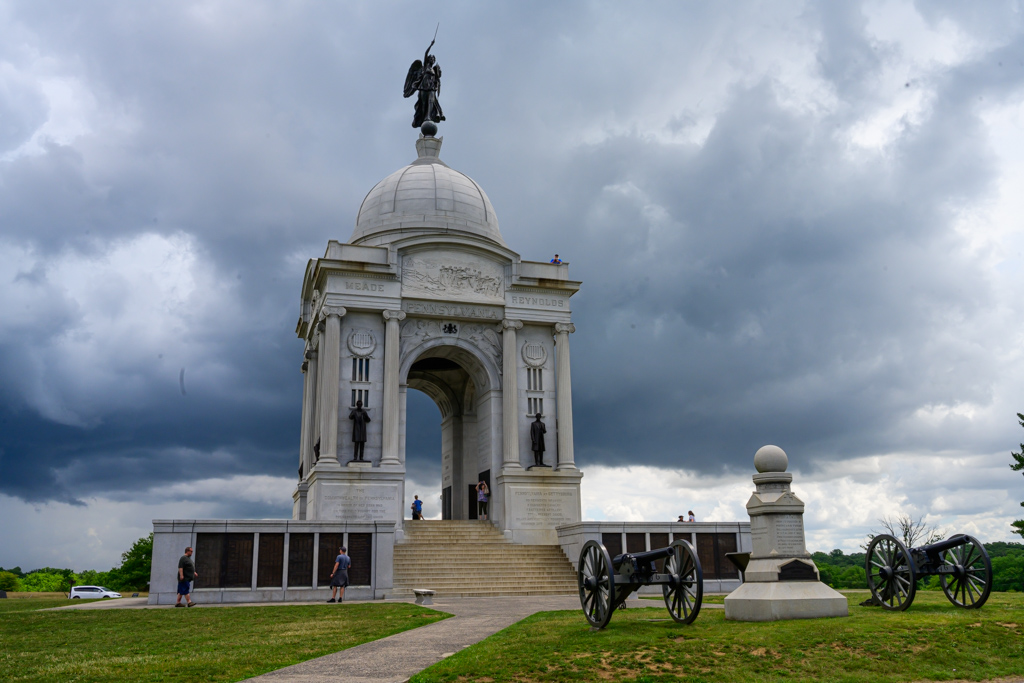
Photo by Jonathan Woytek, June 2023

Jonathan and I travelled to the Gettysburg area for a family event last month. Jonathan had never been to Gettysburg prior to this (except for driving past it on Route 30). So, after we checked out of our hotel, we drove around the battlefield before we drove home.

I learned the night before from a 12-year-old history buff that Little Round Top and Devil’s Den were both under remediation from the National Park Service and thus closed to the public.

“What else should we visit, then?” Jonathan asked me.

I remembered the Pennsylvania Monument and we directed Google maps to give us driving directions to it.

The Pennsylvania Monument is the largest state monument on the battlefield. The Commonwealth of Pennsylvania dedicated the uncompleted monument in 1910. The 50th anniversary commemoration for the battle happened in July 1913. The monument was completed in 1914 and rededicated on July 4, 1914. That’s what Wikipedia says, anyway.

(Wikipedia doesn’t mention this on the monument’s page, but Gavrilo Princip assassinated Archduke Franz Ferdinand on June 28, 1914. This set off a chain of events that resulted in the start of World War I on July 28, 1914. The United States entered World War I in April 1917.)

I didn’t bring my camera with me but Jonathan brought his. You can see the above photo and all of Jonathan’s other Gettysburg photos here on our other blog.

What Jonathan’s other photos didn’t show is this: shortly after we parked at the Pennsylvania monument, a bus bearing the name of a college in northern Michigan pulled up to the monument. Lots of college-looking kids poured out of the bus. A man who looked like a teacher reminded the kids to “remember your assignment.” The kids ascended to the top of the monument.

Now, on the PA monument, one can access a balcony underneath the dome at the top. In order to reach this balcony, you must climb the steps seen in the photo, and then climb a metal spiral staircase that is not seen in the photo.

I overhead a young man talking to a young woman. The young man must have been a member of a fire department, because he referenced “my district” and “fire call.” He told the young woman that the call was for a structure fire. The building in question had a spiral staircase “just like the one here.” He told her that the spiral staircase at said structure fire got very hot and that he had to carry a hose up it. “That was the worst fire call that I’ve ever had,” he said.

In order to get back on their bus, the Michigan college students had to tell their teacher which “spot” they had been assigned to identify, as they pointed in the direction of it. “Peach Orchard,” “Wheat Field,” “Devils Den,” “Little Round Top,” various students said.

A reenactment group positioned across the road from the PA monument demonstrated how to be Civil War infantry soldiers. They marched. They loaded rifles with powder. They fired. There were no bullets. We learned that the National Park Service doesn’t permit the use of bayonets on NPS grounds; nevertheless, we saw a bayonet demonstration sans bayonet. The NPS staffer identified the group as volunteers re-enacting a regiment from Maine. However, three of the men were actually from Germany.

A short trip down the road from the PA monument (the PA monument was still in sight) we stopped to look at some other monuments because a vulture sat on one of these other monuments. The vulture’s mate stood on the ground nearby, eating a squirrel. Jonathan photographed the turkey vulture on the monument. You can see two photos of it on our other blog.

Eventually, another car with a PA license plate pulled up next to our car.

“The vultures return at this same time of year, every year,” the driver told us.

It was about a week before the anniversary of the Battle of Gettysburg.

Jonathan said, “One of them was eating a squirrel before I scared it.”

The driver speculated about the vultures’ presence in July 1863.

“You know what they were feeding on back then, right?” he said.

Then he drove off.

Telegraph Operators and Their Heartbreaking Tragedies

Jonathan and I live in a house built in the 1890’s.

The Alter family originally owned our home. This same family is now buried in a churchyard down the street.

Jonathan researched the Alter family.

Let’s start with the family patriarch, Frank Alter Sr.

Alter was born in 1871 in Pittsburgh.

Alter’s father fought in the Civil War. Alter’s father then maintained a long career with the Allegheny Valley Railroad Company.

Frank Alter Sr.’s own professional life began at age 17 with his own job at the Allegheny Valley Railroad Company as a telegraph operator.  Four years later, he was appointed station agent at New Kensington.

Now, shortly after Alter assumed his first job with the railroad, the Johnstown Flood killed over 2,000 people, in May 1889. A privately-owned dam on a private lake upstream from Johnstown failed. The wall of water demolished the communities that sat between the lake and Johnstown, and then the water hit Johnstown and destroyed it as well.

The flood occurred upstream from New Kensington. It occurred on a tributary to a tributary of the Allegheny River. According to the book “The Johnstown Flood” by David McCullough, flood debris washed downstream from Johnstown, eventually into the Allegheny River, on to Pittsburgh and points beyond. McCullough wrote that somebody plucked a live baby out of the Allegheny River in Verona, which is downstream from New Kensington. McCullough wrote that onlookers stood on the banks of the Allegheny, watching the results of the flood flow past them. Some even plucked souvenirs from the river.

Did Alter first learn about the flood during his duties in the telegraph office? Did he join the crowds which lined the Allegheny River’s banks?

Now, I grew up an hour’s drive south of Johnstown, and my sixth grade class studied the Johnstown Flood. We read excerpts from McCullough’s book.

McCullough acknowledged at the beginning of his book that “most” of the dialogue in Chapters 3 and 4 of his book had been taken directly from a transcription of testimony taken by the Pennsylvania Railroad in the summer of 1889. The railroad’s tracks lined the tributaries hit hardest by the flood. The railroad’s telegraph system documented events leading to the moments before the flood wiped out the tracks and the telegraph lines.

McCullough’s book noted that in the moments before the Johnstown flood happened, a railroad telegraph agent communicated the impending dam failure to Hettie Ogle, who ran the “switchboard and Western Union office” in Johnstown.

McCullough identified Ogle as a Civil War widow who had worked for Western Union for 28 years. The book noted that she was with her daughter Minnie at the time. She passed the message on to her Pittsburgh office. McCullough noted that the two perished in the flood and their bodies were not recovered.

When I was in the sixth grade, I was told that Hettie Ogle faithfully stayed at her telegraph post and relayed river gauge data until at last she wrote:

THIS IS MY LAST MESSAGE

The story haunted me.

Based on how this story was presented to our class, I was under the impression that Hettie Ogle was trapped in the telegraph office with just her daughter. I assumed that Hettie Ogle and her daughter were “rare” because they were women who also worked outside the home at the telegraph office.

Now, here is something that McCullough’s book did NOT tell me, and that I learned instead from the website for the Johnstown Area Heritage Association (JAHA): Ogle was actually trapped in that office with her daughter Minnie, “four other young ladies” who were named by the JAHA website, and also two named men. When I read the website, I understood this to mean that all eight of the named women and men who were trapped in this telegraph office worked in the telegraph industry. They all perished.

I didn’t realize until I first read the JAHA website that Hettie Ogle actually managed an office full of staff. I also didn’t realize that many of the employees in Johnstown’s Western Union office in May 1889 were women.

I have since figured out that if Hettie Ogle worked for Western Union for 28 years until she died in 1889, that means that she started her Western Union career in 1861. The Civil War also started in 1861. As I noted above, she was identified as a war widow. Did she have to take a job with Western Union in order to support her children when her husband went off to war? Did she do it out of a sense of duty for the war effort, and then she stayed with it because she enjoyed the work? What circumstances led her to her “duty” operating the telegraph?

I speculate that since Frank Alter Sr. got his start in the railroad industry as a telegraph operator, the tragedies of the Johnstown Flood would have impacted him personally. Perhaps he even knew some of the telegraph and / or railroad employees who died that day in 1889.

The telegraph industry of the 1800’s fascinates me because I think a great deal about my own dependence on technology.

I first realized how much I – or at least my sense of well-being – depended on being able to keep contact with others and with information on September 11, 2001. I lived in the family home in Somerset County. I worked in downtown Johnstown. Flight 93 crashed between these two points while I was at work that day.

After I and my co-workers watched the twin towers burn live on television, our employer’s co-owner told us to “go back to work.”

However, a few minutes later, this same co-owner’s daughter rushed through the office to announce that a plane had crashed in Somerset County. (This plane, we later learned, was Flight 93.) We learned that we – along with every other worker in downtown Johnstown at that time – were being evacuated because a federal court building existed in downtown Johnstown. I couldn’t reach my family who lived with me in Somerset County on the phone. I attempted, and I had no connection. I then learned that we were being asked to stay off of our phones in order to leave the lines available for emergency crews. I also learned that a portion of Route 219 – the main highway that I used to drive to my family home in Somerset County – was closed due to the morning’s events. I was being forced to leave downtown Johnstown due to the mandatory evacuation, but I had no information about whether I would be able to get back to my home in Somerset County.

I made it home to Somerset County without incident. However, this was the first time that I remember feeling confused because all of my decision making instincts depended on information that I couldn’t access.

More recently, I thought that I was so slick because I specifically curated my Twitter feed to follow the feeds for Pittsburgh’s transit agency, the National Weather Service, and several other emergency management agencies. I worked in downtown Pittsburgh by then, and I commuted home each weeknight – usually by bus – to New Kensington. I reasoned that with my specially curated Twitter feed, I would have available all of the information that I needed to make informed decisions about my commute home if I were to be in Pittsburgh and a natural disaster – or another terrorist attack – happened.

However, on the day that Pittsburgh and its surrounding region had a major flash flooding event, Twitter broke. I had based my entire theoretical emergency plan on having up-to-the date tweets from all of the sources that I listed above. I had access to no updated information from any of these sources.

Once again, I felt completely betrayed by technology at the moment when I felt its need the most.

Now, for another story that I have about being dependent on technology:

I read part of “The Personal Memoirs of Julia Dent Grant (Mrs. Ulysses S. Grant).” Julia Dent Grant (JDG) was born in 1826. In 1844, Samuel Morse sent the United State’s first telegram over a wire from Washington to Baltimore. (Congress partially funded this.) In 1845, JDG’s father, Frederick Dent, travelled from their home in St. Louis to Washington for business. He sent a telegram to Baltimore. JDG wrote that her father received an answer within an hour and that “it savored of magic.” The event was such a big deal that Frederick Dent brought the telegraph repeater tape back home to St. Louis to show the family.

Now I’m going to skip ahead in the memoirs to 1851. At this point in the memoirs, JDG is married to Ulysses S. Grant and they have an infant son. Julia visited family in St. Louis while her husband was stationed at Sackets Harbor, near Watertown, in New York State. JDG planned to telegraph her husband from St. Louis, and then travel with her nurse to Detroit. Then, she would release her nurse and meet her husband in Detroit. Finally, she would travel with her husband from Detroit to Sackets Harbor. I am under the impression that the trip from St. Louis to Detroit to Watertown was all by train.

Well, JDG telegraphed her husband in St. Louis per the plan. She left St. Louis and travelled with her nurse to Detroit. She dismissed her nurse and waited for her husband in Detroit. Her husband never showed up. JDG eventually travelled alone with her baby to Buffalo, hoping to meet her husband there. Her husband wasn’t in Buffalo, so she continued on the train to Watertown. From Watertown, she had to hire a carriage (the Uber of the 1800’s), and travel to Madison Barracks, the military installation at Sackets Harbor. The entrance to Madison Barracks was closed, so she had to yell to get a sentry’s attention.

The telegram that JDG sent to her husband from St. Louis arrived at Sackets Harbor IN THE NEXT DAY’S MAIL.

That’s right – at some point in the journey, the telegram failed to perform its basic function as a telegram. The telegram became snail mail.

After JDG’s husband was promoted during the Civil War, he travelled with his very own personal telegraph operator. (In fact, the Grants learned about President Lincoln’s assassination through a personal telegram received by the personal telegraph operator.)

By the end of the Civl War, the Grants had come a long way since their days of “snail-mail telegrams.”

Other people have actually written entire books about how telegraphs and semaphores affected the Civl War.

Here’s one of my favorite parts of JDG’s memoirs: At one point during the war, JDG asked her father, Frederick Dent, why the country didn’t “make a new Constitution since this is such an enigma – one to suit the times, you know. It is so different now. We have steamers, railroads, telegraphs, etc.

I just find this so fascinating because JDG witnessed her country’s tremendous changes that resulted from Technology. She wondered how all of these Technology changes affected her country.

I, personally, spend a lot of time wondering about how Communication Technology in general – the telegraph, the internet, whatever – changed our national culture and also changed each of us as people.

“Hamilton” -Adjacent: Friendship Hill

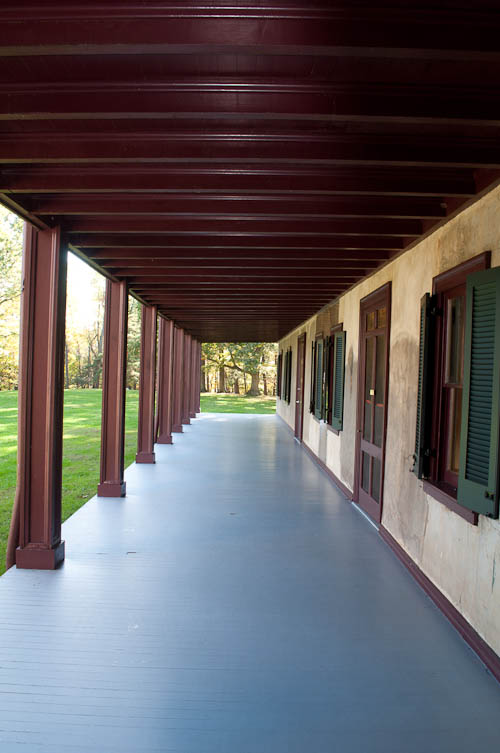
Friendship Hill, Point Marion, Pennsylvania. Photo: Jenny Gaffron Woytek

I found an article titled “Who Was Alexander Hamilton’s Real Nemesis: Aaron Burr or Albert Gallatin and the Jeffersonians?” by Christopher N. Malagisi, dated August 30, 2018, on the Townhall website. This article referenced the book “Jefferson’s Treasure: How Albert Gallatin Saved the New Nation from Debt,” by Gregory May.

The idolized and fabled Alexander Hamilton served as our first Secretary of the Treasury. Hamilton rival Albert Gallatin served as our fourth Secretary of the Treasury.

Thomas Jefferson was the President of the United States who appointed Gallatin as Secretary of the Treasury. Aaron Burr was elected as Jefferson’s Vice President in the election of 1800. So, these guys all knew each other.

Now, my brain totally shut off about one paragraph into reading about the subject matter. Just as it did when I had to learn about the Federalists and the Whigs and the Jeffersonians in high school. So, I don’t have my own fully-formed opinion about whether Albert Gallatin was Hamilton’s real nemesis. I do think that if Lin-Manuel Miranda had rewritten the Hamilton musical so that it was just a bunch of guys arguing about whether Hamilton or Gallatin made a better Secretary of the Treasury, it would not still be on Broadway.

Albert Gallatin owned an estate in Southeastern Pennsylvania. Gallatin’s first wife, Sophia, is buried on the estate. The National Park Service now runs the estate as Friendship Hill National Historic Site. There is no admission fee to visit.

Part of me wishes that Miranda had at least written Gallatin into his “Hamilton” musical – even in a tiny role – so that Point Marion could use it to lure tourists there.

If you want to sight-see while also social distancing, you may want to check out Friendship Hill. Here is my prior blog post about Friendship Hill.

Soldiers’ Lot, Allegheny Cemetery, Pittsburgh

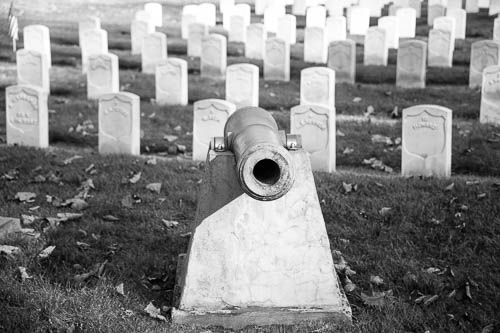
Cannon. Allegheny Cemetery, Pittsburgh, Pennsylvania.
Allegheny Cemetery, Pittsburgh, Pennsylvania. November 10, 2019. (Photo: Jenny Gaffron Woytek)

In 2018, I took a guided tour of Allegheny Cemetery. This cemetery is on the National Register of Historic places.

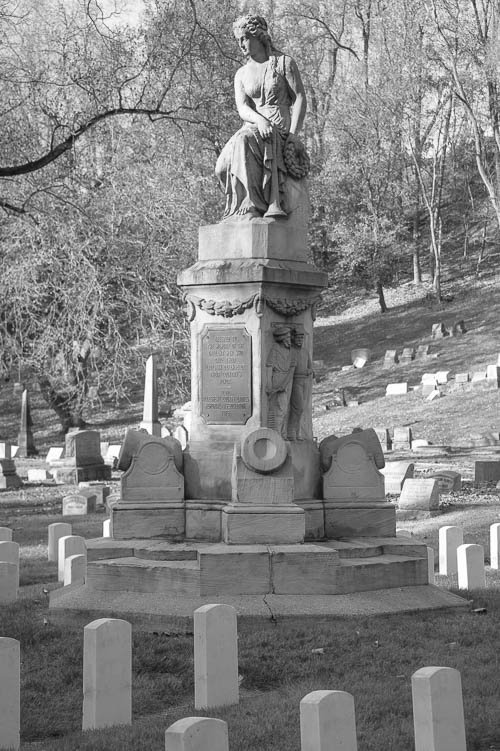
 Allegheny Cemetery includes a National Cemetery Administration’s soldiers’ lot. The Allegheny Cemetery Soldiers’ Lot is located in Section 33 of Allegheny Cemetery. The majority of the 303 soldiers buried here were Civil War soldiers. Most of the burials were of Union soldiers; however, the lot also contains several Confederate soldiers.

I returned to the Soldiers’ Lot in 2019 in order to take some photos.

Allegheny Cemetery, Pittsburgh, Pennsylvania. November 10, 2019. (Photo: Jenny Gaffron Woytek)

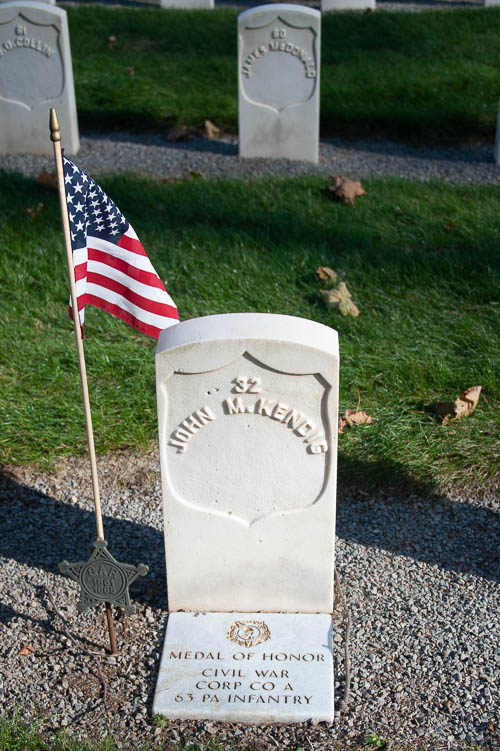
I didn’t have any prior knowledge of this following soldier, but I Googled his name when I returned home.

From the Veterans Affairs / website for Allegheny Cemetery Soldiers’ Lot: Corporal John M. Kendig (Civil War). He received the Medal of Honor while serving in the U.S. Army, Company A, 63rd Pennsylvania Infantry, for actions at Spotsylvania, Virginia, May 12, 1864. His citation was awarded under the name of Kindig. He died in 1869 and is buried in Section 33, Lot 66, Site 32.

Corporal John M. Kendig (Civil War). He received the Medal of Honor.
Allegheny Cemetery, Pittsburgh, Pennsylvania. November 10, 2019. (Photo: Jenny Gaffron Woytek)

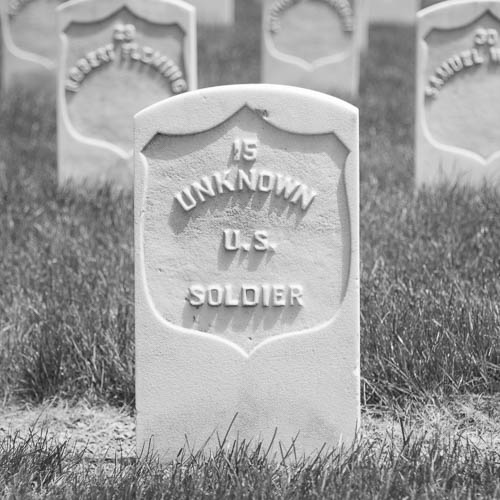
Here’s a grave for an unknown Union (United States) Civil War soldier:

Unknown U.S. Soldier grave.
Allegheny Cemetery, Pittsburgh, Pennsylvania. November 10, 2019. (Photo: Jenny Gaffron Woytek)

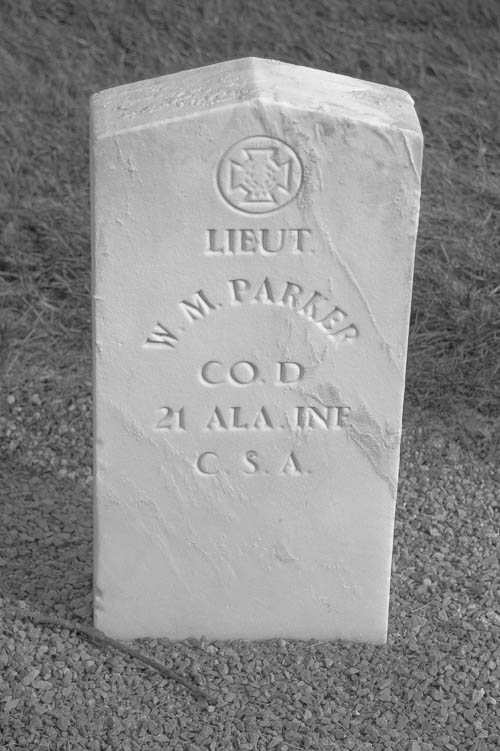
Finally, here is a Confederate grave that I saw at the Soldiers’ Lot. Note how the headstone differs from that of a Union soldier.

Allegheny Cemetery, Pittsburgh, Pennsylvania. November 10, 2019. (Photo: Jenny Gaffron Woytek)

Lock Him Up: An Election Story

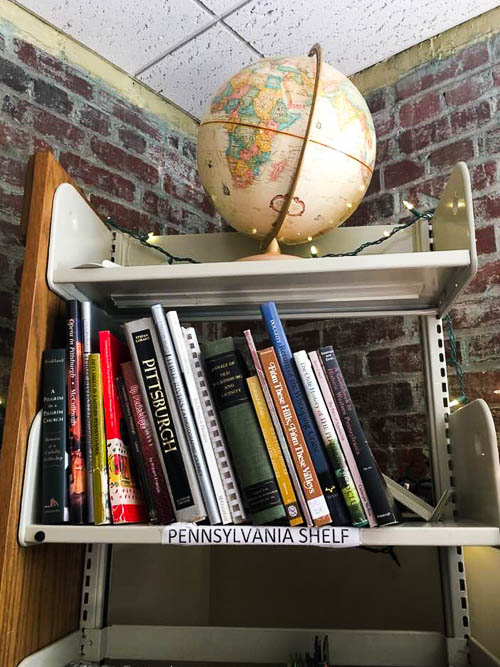
I own a signed copy of Pittsburgh: The Story of An American City, written by Stefan Lorant with several contributors. I purchased it for $5 from a used bookstore. The book came apart in several places at the binding. The book contains almost seven hundred pages of Pittsburgh history and photos.

This book’s Chapter 3 The City Grows by Oscar Handlin includes a sidebar titled Pittsburgh in the News. This sidebar includes the following item:

Joe Barker, a colorful street preacher, was arrested in 1849 when he was involved in a riot while delivering one of his many tirades against Catholicism. He was thrown into jail and while in prison he was elected as mayor of the city. After serving for one year he was defeated for re-election and sank into obscurity. He died in 1862 when run over by a train.

(Wikipedia taught me that the train decapitated Mayor Joseph Barker. He is buried in Allegheny Cemetery.)

Horne’s Department Store

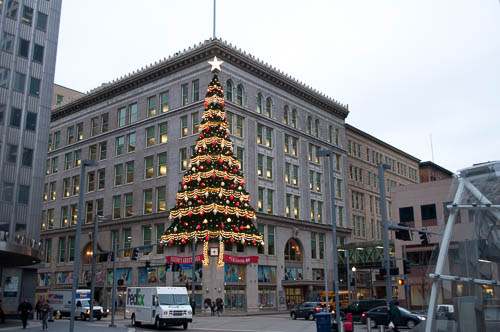
Horne's Department Store Christmas Tree. Highmark building. Downtown Pittsburgh.
Horne’s Department Store. Pittsburgh, PA. December 28, 2015. (Photo: Jenny Gaffron Woytek)

Pittsburgh had a department store chain called Joseph Horne’s, or Horne’s Department Store, or simply Horne’s.

An electric Christmas tree decorated the building’s corner each holiday shopping season.

Horne’s merged with another chain in 1994. Then, the building which housed Horne’s downtown flagship store became offices for an insurance company (Highmark).

However, this tree still graces the building each year from the week before Thanksgiving until New Year’s.

Here is a photo of the building and its tree.

Horne’s Department Store. Pittsburgh, PA. December 18, 2014. (Photo: Jenny Gaffron Woytek)

Everything that I know about Horne’s Department Store came from “American Elegy: A Family Memoir” by Jeffrey Simpson. This particular book detailed the author’s family’s experiences in Parnassus, a sort-of Pittsburgh suburb. In the Chapter titled “Parties (Quint and Ruby),” the author wrote the following about his step-grandmother Ruby’s affinity for shopping at the downtown Pittsburgh Horne’s:

When my mother and Ruby were young women in the late 1920s and 1930s, there was a lounge on Horne’s mezzanine where you could wait for friends. The lounge had a book in which you could leave messages for your chums if you had to leave early or had dashed up to Lingerie for a quick purchase while you were waiting; it was an amenity that seemed to belong to a period of orange minks and nose-tip veils, when girls fresh from college, eager with their first salaries, met “in town” for lunch on Saturday.

Simpson wrote that Ruby grew up “poor” and thus as soon as she received her first very own paycheck, she spent it at Horne’s. Ruby referred to Horne’s as the “good” store. She relished the chance to be seen shopping there. Simpson noted that the Parnassus community and Ruby herself thought that Ruby had married up (to a widower with a good family and a good job). That Ruby’s clothes, purchased from Horne’s, helped her to achieve this marriage.

Simpson concluded:

The Horne’s boxes, cream-colored pasteboard with Jos. Horne Co. in light, bright blue on the lid, represented for Ruby the life she had made for herself.

My own maternal great-grandma worked for Horne’s. However, I don’t have any stories about her retail career.

I myself work directly across the street from the old downtown Horne’s building. I never shopped for clothes there. I grew up in rural Pennsylvania. I started working in Pittsburgh years after Horne’s closed.

When I interviewed for my job, the building housed an Old Navy store.

By the time that I started my job, the Old Navy was a Rite Aid.

Remember the End: Greensburg Historical Fiction

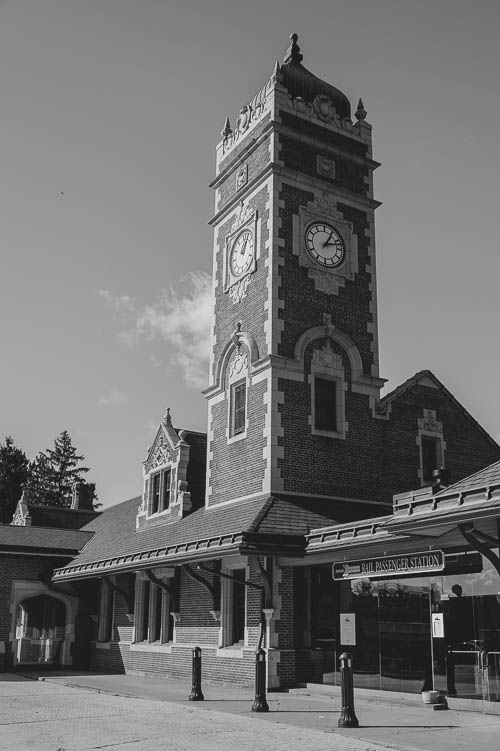
Greensburg Station. Greensburg, Pennsylvania. Photo taken November 3, 2019. This is now the Greensburg Amtrak station. This was originally a Pennsylvania Railroad station. The station opened in 1912. (Photo: Jenny Gaffron Woytek)

I have family who lived in the Greensburg-ish, Pennsylvania, area in the early 1900’s. A bunch of them died young and / or poor, so I can’t tell you much about them. However, because of them, I got stuck on Western PA history.

I read this historical fiction novel titled “Remember the End” by Agnes Sligh Turnbull. Turnbull was a New York Times bestselling writer from New Alexandria, PA.

Turnbull graduated from Indiana University of Pennsylvania (IUP). (My sister, a double IUP grad, told me that IUP used to have a Turnbull Hall. This got knocked down and replaced with a parking lot.)

Anyway, Turnbull wrote Remember the End. This novel began in the late 1800’s in Scotland, then moved to the Greensburg area, then ended in Greensburg around 1917.

(The book didn’t actually list dates. I only knew that the book ended around 1917 because at the end of the story, several of the characters talked about fighting in the War (World War I). The War started in 1914. The United States entered the War in 1917. )

At the very beginning of Remember the End, (the very poor) Alex McTay left his home in Scotland. He emigrated to Pennsylvania. He fell in love with Maggie, a (poor, but not quite as poor) Westmoreland County horse trader’s daughter.

Alex married Maggie. He opened coal mines. He became a millionaire before his 35th birthday. He built a fancy home for Maggie in Greensburg.

I think that Turnbull based the protagonist on a hybrid of Andrew Carnegie and Henry Clay Frick. At one point in the story, McTay referred to Andrew Carnegie as his hero or his role model or something.

Unlike Andrew Carnegie, McTay didn’t become a philanthropist.

McTay deliberately ruined his business rival’s life after the rival humiliated him at a fancy Greensburg party.

Remember the End haunts me because my family lived in Western PA during this same time frame. Fictional Alex McTay’s fortune could very well have been built upon my family’s backs.

I posted above a photo of Greensburg’s train station. The Pennsylvania Railroad built this station in 1912. So, if Alex McTay existed in real life, he and his family could have travelled through this station. Did Turnbull visualize Alex McTay in this station?

Turnbull is now buried in New Alexandria. Remember the End is now out of print. I purchased my copy used.

Confederate Grave, Pittsburgh, PA

LIEUT W.M. Parker CO. D 21 ALA. INF C.S.A.
Allegheny Cemetery, Pittsburgh, PA. November 10, 2019. (Photo: Jenny Gaffron Woytek)

I took this at the Allegheny Cemetery Soldiers’ Lot, Lawrenceville, Pittsburgh, PA. This headstone marks the grave of a Confederate soldier from the American Civil War. (C.S.A. stands for “Confederate States of America.”)

The Parnassus Pen All content copyright by author, unless otherwise noted.