The Wedding Dress Post

My youngest sister, O., is planning her autumn wedding.

Last month, she invited all of us Gaffron sisters and several of her fiance’s family members to shop for dresses with her. We sisters had a “Girl’s Weekend” which included pool time at a hotel. In fact, another hotel guess commented to me that it looked as if we were having a “Girl’s Weekend.”

O. did say “yes to the dress” that weekend. Almost everyone that loves her will need to wait until this autumn to see the “big reveal” for this dress. So let me tell you about a dress from another autumn wedding.

I present to you “The Dress” that my mother, Shirley, sewed for her wedding to my father in the autumn of 1974. Mom met my dad several weeks before her 16th birthday. Dad gave her roses for her Sweet 16 because his mother told him that it would be a nice thing for him to do. They married several weeks before Mom’s 20th birthday. Dad had just graduated from college and he had just started his first teaching job.

Both of my parents are no longer with us. I can tell you about how young they were and show you photos of how cute they were without getting myself into trouble.

The summer before the wedding, Dad took what little money he had and he went shopping someplace in Westmoreland County near where he grew up. He needed a suit for his new teaching job, and he needed a suit for his wedding. He only had enough money to purchase one of these suits. The salesman at the suit store approached him. Dad introduced himself and explained the purpose of his shopping trip. The salesman said, “What did you say your name is again?” Dad repeated his name. The salesman said, “I’m the owner of this store. My last name is also Gaffron. I’m your dad’s cousin. Tell you what. If you buy one suit, then I’ll throw in a second suit as a wedding gift from my branch of the family.”

At least that was how Dad told the story. I have no idea how much of this is actually true. Any questions would just destroy the “magic.”

Anyway, back to The Dress. Mom sewed it on the same sewing machine that she used to sew all of the clothes that she made for our family. (My sister blogged a little bit here about the “Little House on the Prairie” outfits that Mom made us.) The leftover material from the sleeves ended up in her fabric scrap collection. I used some of these fabric scraps to make accessories for my Barbie when I married Barbie off to Ken. I still have some remaining scraps for an as-yet unknown future project.

Here’s a full length portrait of my mom wearing The Dress. My dad is also in this portrait. He is wearing the suit that his “surprise cousin” allegedly gifted him on behalf of a mystery branch of the Gaffron family.

I took Mom’s dress, her veil, and her wedding album back to my house when we prepared to sell the house in Berlin. My sister O. modeled The Dress (Mom’s dress, that is) and The Veil in front of my Christmas tree last December. It fit her!

My mom’s name was Shirley. O’s middle name is also Shirley. So now we have two brides with Shirley in their names.

Let me tell you about yet another bride named Shirley. This Shirley was my maternal grandmother’s only sister. She passed away before my mom was born. Here is a photo of Shirley on her wedding day, standing with Grandma.

Shirley didn’t have any children of her own. So, I get to be the one to tell you blog readers about her. Here is what I know about this Shirley: my grandma missed her very much. A few years before Grandma passed away at the age of 90, she and I sat down with all of her photo albums. Grandma showed me many photos of her with her sister Shirley.

It is my understanding that this Shirley got married in the early 1950’s. I don’t know anything about her dress or about the dress that my grandma wore in this photo.

Even though my mom made her own wedding dress, I know a tiny bit about wedding dress shopping in the 1970’s. My late mother-in-law, Fran, married my father-in-law, Dennis, in 1974. They actually got married just a few weeks before my own parents got married. My in-laws and my own parents all belonged to the baby boomer generation. (My parents disliked the term “baby boomer.”) Fran told me that so many women shopped for wedding dresses in the 1970’s that the Pittsburgh department stores had dedicated wedding dress sections. Fran found her wedding dress in one such department store. Fran said “Yes to the Dress” because the embroidery included one of her favorite flowers.

In the very late 1970’s or the very early 1980’s, Mom brought me to her own sister’s wedding shower. It was held at somebody’s apartment in Pittsburgh. I ghosted the event (otherwise known as a “French exit” or an “Irish goodbye”) in order to check out the building’s elevator. I was still riding in the elevator when Mom found me. I wasn’t a big fan of weddings back then. But I enjoy them now.

Voluntold; The Story of the Time that My Dad Volunteered My Mom for a Project

This is my second grade soccer photo.

If anybody reading this blog identifies themself in this photo and they object to it, please reach out and I will put a big ‘ol Eat N’ Park Smiley Face or something over your mug. Most of this post is actually going to be about the team banner shown in this photo.

For the first few years after we moved to Berlin, I played AYSO soccer. A lot of my classmates also played AYSO soccer. The team in this photo was just one of many teams of kids my age who went to school in Berlin. Our AYSO teams were all co-ed. I later graduated from high school with many of the kids in this photo. The exceptions were the kids who were my age but were in other grades, and the kid who moved in junior high. (The birthday cut-off for teams for AYSO soccer was slightly different than the birthday cut-off for our school district.)

Berlin’s varsity soccer program started after I left high school. Our town didn’t have any “permanent” soccer facilities when I was a kid. The “soccer fields” that I played on during my short soccer career all became other things. For instance, most of our elementary school soccer games were held on a farmer’s then-fallow cornfield. A few years later, it became a planted cornfield. There was another, smaller “soccer field” in town where the kindergarten kids practiced and played their AYSO soccer games. We also played pick-up soccer with the neighborhood kids on the “kindergarten soccer field.” When I was in high school, the parents of one of those neighborhood kids custom built their Forever Home on the lot that was formerly the “kindergarten soccer field.”

(Disclaimer: I think that one of my childhood soccer fields was a fallow cornfield. I could be wrong about this. Maybe it was a wheatfield? I saw farms from my backyard. Our house was on the very edge of town. We certainly smelled them. My entire eighth grade class was required to take Vocational Agriculture. A lot of my classmates lived on farms and I didn’t. I mis-remember a lot of things, so I could be wrong about the corn.)

My soccer career started in March of second grade, a few months after we moved into “Joe’s House.” I am pretty sure that my soccer career was my dad’s idea.

Now it’s time to talk about something else that was my dad’s idea.

Dad took me to my soccer team’s introductory meeting, held in the school cafeteria. This was where we learned the rules, and voted on a team name. (“Firebolts” won the vote for team name.) This was also the meeting where the coach asked for a volunteer to make the team banner. Our team’s official sponsor was Keidel’s Hardware. Both the team name and the team banner needed to include Keidel’s. Spoiler: my dad volunteered my mom to make the team banner! And she wasn’t there! She was at home with their other two young kids.

I do remember how all of this went down. We came home from the soccer meeting. My dad said to my mom something like, “I volunteered you to make the banner since you like to sew!” My mom wasn’t as excited as my dad was.

Less than two months later, my parents purchased their house in Berlin. My mom repainted the living room while we were at school. My parents moved all of our stuff out of “Joe’s House” and into “Our House.” I celebrated my First Communion at our new Catholic parish the same month that we moved into Chez Gaffron. Mom found out during my First Communion rehearsal that every mom there except for her had planned a family party to celebrate their child’s First Communion. (Mom’s own parents didn’t “do” First Communion parties. Dad’s family were Protestants. Mom didn’t realize that First Communion parties were a thing. She threw one together for me. Our extended family showed up so that they could see my parents’ new house. I got a cake and presents, and it wasn’t even my birthday yet.)

My first soccer game happened a week after we moved and a week or so before my First Communion.

I understand why Mom didn’t realize that when she dropped me off for the warmup before my first soccer game, that she was also supposed to drop off the banner. There was a lot going on in our family. Also, Mom didn’t want to make the banner in the first place.

The coach and the “team mother,” or whatever they called the woman who organized everything, said to me, “Jenny, where is the banner that your mom made?”

I didn’t know. (I think that she was at my younger sister’s soccer game, which was probably held at the exact same time, at the “Kindergarten Soccer Field” that I mentioned above.)

They asked me for my parents’ new phone number. I didn’t know that either. We had only moved a week earlier.

Someone tracked my mom down (probably at my sister’s soccer game) and asked her to bring the banner to my soccer game.

Mom showed up at my soccer game with the banner and explained, “I haven’t finished it yet.”

I don’t think that Mom ever finished the team banner for Keidel’s Firebolts. The top of the banner looks sort of “unpopulated” in our team photo. However, the bottom of the banner has a cool-looking thunderbolt. You just can’t see it because kids are standing in front of it in this photo. So maybe that was her artistic vision for it. Mom was very talented in multiple textile arts, although we never said it like that. We just said, “Mom is good at sewing,” or “Mom is good at needlepoint,” or “Mom is good at crochet,” or “Mom just taught herself how to knit a sweater from watching YouTube videos,” or “Mom owns a lot of yarn.”

Mom also sewed her own wedding dress. I plan to post a photo of it soon. Unlike the soccer banner for Keidel’s Firebolts, Mom decided on her own to make her wedding dress. We still have it and cherish it very much, just as I cherish the memories of my parents during our first spring in Berlin.

Snyder of Berlin and the “Joe’s House” Era

My four sisters and I sold the house where we all grew up, in Berlin, PA, a little over a year ago, after our dad died.

A few months ago, I learned that the company who owned the town’s potato chip factory intended to shutter it. The news was so shocking that my sisters and I texted each other about it. The Chip Plant? Oh, no, not the Chip Plant!

(We all called it the “Chip Plant.”)

Snyder of Berlin potato chips were one of my first introductions to Berlin.

My parents moved us to Somerset County when I was seven years old. My dad had accepted a position teaching Special Education at Somerset Area High School. Berlin is not in the Somerset Area School District. Berlin is in the Berlin Brothersvalley School District. My dad’s brother and the brother’s family lived a few miles outside of Berlin. My dad wanted to live close to my uncle. So, he rented a house a mile or two down the highway from my uncle. My dad knew that it would be an “easy” commute to Somerset because my uncle also worked in Somerset.

My sisters and I called the rental house “Joe’s House.” My parents rented it from a man named Joe. They also rented the house from Joe’s wife (we called her Joe’s Wife) and Joe’s daughter, Rita.

Joe used to live in Joe’s House with his wife and several kids. All of the kids left the nest except Rita. Joe, Joe’s Wife, and Rita moved out of their house and into an apartment on top of their garage. Then Joe rented Joe’s House to my parents.

Joe’s Garage was actually Joe’s Welding Shop. Joe’s Wife worked at Snyder of Berlin. The day after my parents moved us into Joe’s House, Joe’s Wife brought us several bags of Snyder of Berlin potato chips. She introduced us to the potato chip brand and to the role of Snyder of Berlin in our new community.

A few days later, I visited Berlin for the first time. The potato chip factory was a short walk down a residential street from our new school.

Rita rode the school bus with me and my sister K. Rita was a senior in high school. I was in the second grade. K. was in kindergarten. The Berlin Brothersvalley School District at that time educated their entire student population in two buildings connected by an “underground tunnel.” (Just like the US Capitol, except that it was traversed each day by a few hundred kids.) I thought that Rita was cool because she sat with (and horseplayed with) the other high school kids in the back of the bus.

Rita told me that my new bedroom at “Joe’s House” had been her bedroom. You know, before her parents moved her out of her house and rented the house to another family. Rita had to ride the bus each morning with the little girls who now slept in “her” bedroom.

I wonder if we should have all called the house “Rita’s House.”

A few months after my family moved into Joe’s House, we moved out of Joe’s House. My parents found a house to purchase in the town of Berlin. We walked to school. Berlin was small enough that we rode our bikes to every corner of the town. I often rode my bike past the Chip Plant.

Rita graduated from high school. I saw her name proudly written on a paper graduation cap taped to the wall of our shared school cafeteria. I was proud that I, a newcomer and a second grader, recognized a name on that wall. I graduated from that same school ten years later.

I smelled fried potatoes on windy days while I sat in class. We took Economics and did Junior Achievement in our senior year. As our “field trip,” we walked down the street and toured the Snyder of Berlin factory. There were 78 of us in my senior class. We divided ourselves into groups of five to ten each and laughed at the hair nets that we all wore. Some of my classmates waved at their family members working on the assembly line. When my sister K. took Economics / Junior Achievement two years later, a manager from the Snyder plant visited their class several times. He gave her a bunch of Snyder swag.

Every time my family rode past Joe’s House, we explained, “That’s Joe’s House!” Then a few moments later we pointed out the house that my uncle and aunt used to own. Two of my sisters were born after the “Joe’s House” era, so they needed to know about it.

I’m not going to get into the details about why the potato chip factory in Berlin got shuttered. You can Google all that. However, it closed last month.

I assume that Joe’s Wife eventually retired from the Chip Plant. However, a bunch of my former classmates and / or their family members probably didn’t have this opportunity. The Chip Plant’s role in Berlin will be hard to replace.

My Great-Grandfather Left His Immigrant Family to Serve in World War I, Become a POW, and Lose the Use of His Arm

I will occasionally blog about stuff that my sisters and I found when we cleaned out our late parents’ house.

For instance, here are two books that we found. They belonged to our paternal great-grandfather, Leonard Robert Gaffron. (My uncle Leonard and my father Robert were both named after him.)

Leonard Gaffron was a veteran of World War I.

The book above says on the cover:

80th

DIVISION

SUMMARY OF OPERATIONS

IN THE

WORLD WAR

PREPARED BY THE

AMERICAN BATTLE MONUMENTS

COMMISSION

The inside page says the same thing, with this added:

United States Government

Printing Office

1944

So, while my grandfather Carl was away serving in World War II in 1944, his own father, Leonard, received a book from the US government about a summary of operations in World War I.

The second book says the following on the cover:

WAR DIARY

of

COMPANY “E”

320TH INFANTRY

Compiled upon the occasion of the Eighth Annual Reunion, commemorating the Tenth Anniversary of the Company’s organization at Camp Lee, Virginia

September Nineteen Seventeen

June Nineteen Nineteen

The inside page says:

DEDICATED to all the men of Company “E”, 320th Infantry [80th Division], who made the supreme sacrifice.

According to family lore, Leonard Gaffron was a tremendous athlete. Before the War, he pitched a no hitter in a local baseball game. During the War, the Germans wounded him in the arm that he used to pitch the no-hitter. The Germans also took him prisoner. The Germans released him, but he lost the use of that arm due to his injury. At some point after the War, he went back to playing baseball- with his other arm. He pitched another no-hitter.

According to my dad, his Grandfather Gaffron earned a living by farming with one arm and two mules. He named one of the mules Kaiser Bill. (This was a reference to Kaiser Willhelm II, the German emperor during World War I.)

Years after World War I, a local newspaper interviewed my great-grandfather about his experience as a POW. My dad’s cousin brought a copy of this article to last year’s family reunion. He put the article up on a big screen so that we could all read it.

The article left out stuff that we Gaffrons had heard in the family lore. For instance, the article downplayed my great-grandfather’s ability to communicate with his German captors. My great-grandfather spoke German fluently. His parents were German immigrants.

My family concluded last fall that the article differed from the family lore because the article writer – or my great-grandfather, or both of them – didn’t want to draw attention to his German immigrant background. Somebody was apparently worried about the optics of his experience as a POW.

I never met Leonard Gaffron because he died before I was born. I have no idea if the Gaffrons who immigrated from Germany were a bunch of jerks. This doesn’t matter. Leonard had to farm and play baseball with one arm after he was captured as a POW in the War. From the family lore, the household struggled between World War I and World War II. The Great Depression happened, everyone struggled, but Leonard had to struggle with one arm.

Leonard’s son Carl went off to serve the U.S. in World War II. Then Carl came home and eventually married into another German immigrant family.

While we consider ourselves Americans now, some used to consider us outsiders. Interesting how a generation or two can affect our viewpoints.

St. Mary of Czestochowa Parish Blessing of Food Baskets – Holy Saturday, Easter Weekend

St. Mary of Czestochowa Parish Blessing of Food Baskets, New Kensington, Saturday April 19, 2025
Rev. John Moineau, St. Mary of Czestochowa Parish Blessing of Food Baskets, New Kensington, Saturday April 19, 2025

Sunset at Mount Saint Peter

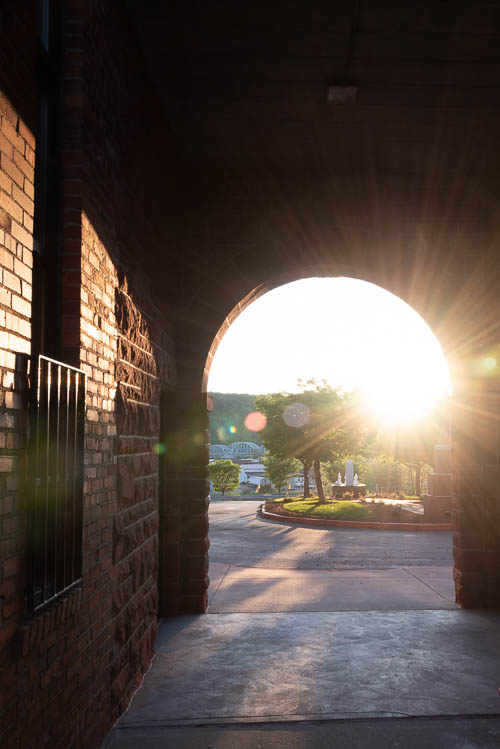
Mount Saint Peter Roman Catholic Church. New Kensington, Westmoreland County, Pennsylvania. May 7, 2021. (Photo: Jenny Gaffron Woytek)

Mount Saint Peter Roman Catholic Church. New Kensington, Westmoreland County, Pennsylvania. May 7, 2021. (Photo: Jenny Gaffron Woytek)

Telegraph Operators and Their Heartbreaking Tragedies

Jonathan and I live in a house built in the 1890’s.

The Alter family originally owned our home. This same family is now buried in a churchyard down the street.

Jonathan researched the Alter family.

Let’s start with the family patriarch, Frank Alter Sr.

Alter was born in 1871 in Pittsburgh.

Alter’s father fought in the Civil War. Alter’s father then maintained a long career with the Allegheny Valley Railroad Company.

Frank Alter Sr.’s own professional life began at age 17 with his own job at the Allegheny Valley Railroad Company as a telegraph operator.  Four years later, he was appointed station agent at New Kensington.

Now, shortly after Alter assumed his first job with the railroad, the Johnstown Flood killed over 2,000 people, in May 1889. A privately-owned dam on a private lake upstream from Johnstown failed. The wall of water demolished the communities that sat between the lake and Johnstown, and then the water hit Johnstown and destroyed it as well.

The flood occurred upstream from New Kensington. It occurred on a tributary to a tributary of the Allegheny River. According to the book “The Johnstown Flood” by David McCullough, flood debris washed downstream from Johnstown, eventually into the Allegheny River, on to Pittsburgh and points beyond. McCullough wrote that somebody plucked a live baby out of the Allegheny River in Verona, which is downstream from New Kensington. McCullough wrote that onlookers stood on the banks of the Allegheny, watching the results of the flood flow past them. Some even plucked souvenirs from the river.

Did Alter first learn about the flood during his duties in the telegraph office? Did he join the crowds which lined the Allegheny River’s banks?

Now, I grew up an hour’s drive south of Johnstown, and my sixth grade class studied the Johnstown Flood. We read excerpts from McCullough’s book.

McCullough acknowledged at the beginning of his book that “most” of the dialogue in Chapters 3 and 4 of his book had been taken directly from a transcription of testimony taken by the Pennsylvania Railroad in the summer of 1889. The railroad’s tracks lined the tributaries hit hardest by the flood. The railroad’s telegraph system documented events leading to the moments before the flood wiped out the tracks and the telegraph lines.

McCullough’s book noted that in the moments before the Johnstown flood happened, a railroad telegraph agent communicated the impending dam failure to Hettie Ogle, who ran the “switchboard and Western Union office” in Johnstown.

McCullough identified Ogle as a Civil War widow who had worked for Western Union for 28 years. The book noted that she was with her daughter Minnie at the time. She passed the message on to her Pittsburgh office. McCullough noted that the two perished in the flood and their bodies were not recovered.

When I was in the sixth grade, I was told that Hettie Ogle faithfully stayed at her telegraph post and relayed river gauge data until at last she wrote:

THIS IS MY LAST MESSAGE

The story haunted me.

Based on how this story was presented to our class, I was under the impression that Hettie Ogle was trapped in the telegraph office with just her daughter. I assumed that Hettie Ogle and her daughter were “rare” because they were women who also worked outside the home at the telegraph office.

Now, here is something that McCullough’s book did NOT tell me, and that I learned instead from the website for the Johnstown Area Heritage Association (JAHA): Ogle was actually trapped in that office with her daughter Minnie, “four other young ladies” who were named by the JAHA website, and also two named men. When I read the website, I understood this to mean that all eight of the named women and men who were trapped in this telegraph office worked in the telegraph industry. They all perished.

I didn’t realize until I first read the JAHA website that Hettie Ogle actually managed an office full of staff. I also didn’t realize that many of the employees in Johnstown’s Western Union office in May 1889 were women.

I have since figured out that if Hettie Ogle worked for Western Union for 28 years until she died in 1889, that means that she started her Western Union career in 1861. The Civil War also started in 1861. As I noted above, she was identified as a war widow. Did she have to take a job with Western Union in order to support her children when her husband went off to war? Did she do it out of a sense of duty for the war effort, and then she stayed with it because she enjoyed the work? What circumstances led her to her “duty” operating the telegraph?

I speculate that since Frank Alter Sr. got his start in the railroad industry as a telegraph operator, the tragedies of the Johnstown Flood would have impacted him personally. Perhaps he even knew some of the telegraph and / or railroad employees who died that day in 1889.

The telegraph industry of the 1800’s fascinates me because I think a great deal about my own dependence on technology.

I first realized how much I – or at least my sense of well-being – depended on being able to keep contact with others and with information on September 11, 2001. I lived in the family home in Somerset County. I worked in downtown Johnstown. Flight 93 crashed between these two points while I was at work that day.

After I and my co-workers watched the twin towers burn live on television, our employer’s co-owner told us to “go back to work.”

However, a few minutes later, this same co-owner’s daughter rushed through the office to announce that a plane had crashed in Somerset County. (This plane, we later learned, was Flight 93.) We learned that we – along with every other worker in downtown Johnstown at that time – were being evacuated because a federal court building existed in downtown Johnstown. I couldn’t reach my family who lived with me in Somerset County on the phone. I attempted, and I had no connection. I then learned that we were being asked to stay off of our phones in order to leave the lines available for emergency crews. I also learned that a portion of Route 219 – the main highway that I used to drive to my family home in Somerset County – was closed due to the morning’s events. I was being forced to leave downtown Johnstown due to the mandatory evacuation, but I had no information about whether I would be able to get back to my home in Somerset County.

I made it home to Somerset County without incident. However, this was the first time that I remember feeling confused because all of my decision making instincts depended on information that I couldn’t access.

More recently, I thought that I was so slick because I specifically curated my Twitter feed to follow the feeds for Pittsburgh’s transit agency, the National Weather Service, and several other emergency management agencies. I worked in downtown Pittsburgh by then, and I commuted home each weeknight – usually by bus – to New Kensington. I reasoned that with my specially curated Twitter feed, I would have available all of the information that I needed to make informed decisions about my commute home if I were to be in Pittsburgh and a natural disaster – or another terrorist attack – happened.

However, on the day that Pittsburgh and its surrounding region had a major flash flooding event, Twitter broke. I had based my entire theoretical emergency plan on having up-to-the date tweets from all of the sources that I listed above. I had access to no updated information from any of these sources.

Once again, I felt completely betrayed by technology at the moment when I felt its need the most.

Now, for another story that I have about being dependent on technology:

I read part of “The Personal Memoirs of Julia Dent Grant (Mrs. Ulysses S. Grant).” Julia Dent Grant (JDG) was born in 1826. In 1844, Samuel Morse sent the United State’s first telegram over a wire from Washington to Baltimore. (Congress partially funded this.) In 1845, JDG’s father, Frederick Dent, travelled from their home in St. Louis to Washington for business. He sent a telegram to Baltimore. JDG wrote that her father received an answer within an hour and that “it savored of magic.” The event was such a big deal that Frederick Dent brought the telegraph repeater tape back home to St. Louis to show the family.

Now I’m going to skip ahead in the memoirs to 1851. At this point in the memoirs, JDG is married to Ulysses S. Grant and they have an infant son. Julia visited family in St. Louis while her husband was stationed at Sackets Harbor, near Watertown, in New York State. JDG planned to telegraph her husband from St. Louis, and then travel with her nurse to Detroit. Then, she would release her nurse and meet her husband in Detroit. Finally, she would travel with her husband from Detroit to Sackets Harbor. I am under the impression that the trip from St. Louis to Detroit to Watertown was all by train.

Well, JDG telegraphed her husband in St. Louis per the plan. She left St. Louis and travelled with her nurse to Detroit. She dismissed her nurse and waited for her husband in Detroit. Her husband never showed up. JDG eventually travelled alone with her baby to Buffalo, hoping to meet her husband there. Her husband wasn’t in Buffalo, so she continued on the train to Watertown. From Watertown, she had to hire a carriage (the Uber of the 1800’s), and travel to Madison Barracks, the military installation at Sackets Harbor. The entrance to Madison Barracks was closed, so she had to yell to get a sentry’s attention.

The telegram that JDG sent to her husband from St. Louis arrived at Sackets Harbor IN THE NEXT DAY’S MAIL.

That’s right – at some point in the journey, the telegram failed to perform its basic function as a telegram. The telegram became snail mail.

After JDG’s husband was promoted during the Civil War, he travelled with his very own personal telegraph operator. (In fact, the Grants learned about President Lincoln’s assassination through a personal telegram received by the personal telegraph operator.)

By the end of the Civl War, the Grants had come a long way since their days of “snail-mail telegrams.”

Other people have actually written entire books about how telegraphs and semaphores affected the Civl War.

Here’s one of my favorite parts of JDG’s memoirs: At one point during the war, JDG asked her father, Frederick Dent, why the country didn’t “make a new Constitution since this is such an enigma – one to suit the times, you know. It is so different now. We have steamers, railroads, telegraphs, etc.

I just find this so fascinating because JDG witnessed her country’s tremendous changes that resulted from Technology. She wondered how all of these Technology changes affected her country.

I, personally, spend a lot of time wondering about how Communication Technology in general – the telegraph, the internet, whatever – changed our national culture and also changed each of us as people.

“Hamilton” -Adjacent: Friendship Hill

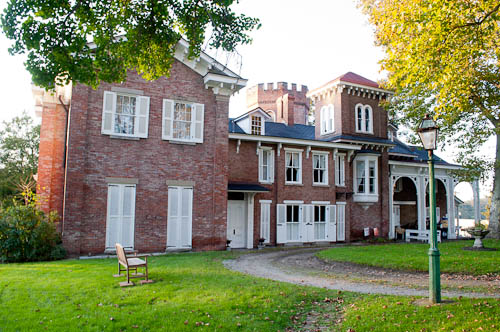
Friendship Hill, Point Marion, Pennsylvania. Photo: Jenny Gaffron Woytek

I found an article titled “Who Was Alexander Hamilton’s Real Nemesis: Aaron Burr or Albert Gallatin and the Jeffersonians?” by Christopher N. Malagisi, dated August 30, 2018, on the Townhall website. This article referenced the book “Jefferson’s Treasure: How Albert Gallatin Saved the New Nation from Debt,” by Gregory May.

The idolized and fabled Alexander Hamilton served as our first Secretary of the Treasury. Hamilton rival Albert Gallatin served as our fourth Secretary of the Treasury.

Thomas Jefferson was the President of the United States who appointed Gallatin as Secretary of the Treasury. Aaron Burr was elected as Jefferson’s Vice President in the election of 1800. So, these guys all knew each other.

Now, my brain totally shut off about one paragraph into reading about the subject matter. Just as it did when I had to learn about the Federalists and the Whigs and the Jeffersonians in high school. So, I don’t have my own fully-formed opinion about whether Albert Gallatin was Hamilton’s real nemesis. I do think that if Lin-Manuel Miranda had rewritten the Hamilton musical so that it was just a bunch of guys arguing about whether Hamilton or Gallatin made a better Secretary of the Treasury, it would not still be on Broadway.

Albert Gallatin owned an estate in Southeastern Pennsylvania. Gallatin’s first wife, Sophia, is buried on the estate. The National Park Service now runs the estate as Friendship Hill National Historic Site. There is no admission fee to visit.

Part of me wishes that Miranda had at least written Gallatin into his “Hamilton” musical – even in a tiny role – so that Point Marion could use it to lure tourists there.

If you want to sight-see while also social distancing, you may want to check out Friendship Hill. Here is my prior blog post about Friendship Hill.

The Parnassus Pen All content copyright by author, unless otherwise noted.