I Read “Yesteryear” This Week

My sister posted a few weeks ago about our shared obsession with anything adjacent to “Little House on the Prairie.” It was the early 80’s. Michael Landon starred as the frequently bare-chested Charles “Pa” Ingalls in the television drama adapted from Laura Ingalls Wilder’s “Little House” books. I was barely in elementary school, so I paid no attention to Pa Ingall’s six-pack. I paid a lot of attention to Laura’s braided hair and her bonnets. And her numerous sisters. I had long brown braids, just like Laura’s! Our mom sewed us our own bonnets and matching ruffled nightgowns. I had a lot of sisters, just like Laura.

We lived in rural central Pennsylvania when our “Little House” fascination began. Or, rather, we were born into our “Little House” era. Amish farms surrounded our small town. (The town often smelled like manure.) Our family drove past the farms in our station wagon, and I watched Amish kids my age run around barefoot. Amish families travelled past our house in their black, horse-drawn buggies. An Amish family even owned the local bakery / bookstore! (Mom took me to the Amish store and I picked out a book for myself. The owners’ son rang me up at the counter. He had six fingers on each hand. Mom told me that the young man’s parents established a store for him to run because he was unable to work on the family farm. Years later, I saw a photo in my high school biology textbook of a six-fingered hand that resembled the hands of the store owners’ son. The book introduced me to the term “Ellis-van Creveld syndrome,” a “genetic disorder in the Amish community.”)

The town’s volunteer fire chief owned the deli directly across the street from the volunteer fire station. The fire chief answered the fire department’s landline phone while he filled deli orders. The all-volunteer ambulance station sat next to the fire station. My dad volunteered on the ambulance crew because the town was so small that everyone had to volunteer to do something, or else the town wouldn’t have basic emergency services. That’s how small and isolated our town was. When our elderly neighbor suffered a fatal sudden cardiac arrest, my dad was on the ambulance crew that responded. Another time, a local Amish boy fell out of a hay loft and suffered a head injury. Dad had to drive the ambulance that transported him 50 miles to Hershey Medical Center. Medical helicopter evacuations didn’t exist in our community back in the “olden days” of my childhood.

I read all of Laura Ingalls Wilder’s original “Little House” books, and also that bummer of a memoir about her newlywed life “The First Four Years.” (Spoiler alert: Laura and Almonzo’s infant son dies. Their crop fails at least once, maybe several times. Then, she burns down their first house in a cooking accident.)

Our aunt gifted us a book titled “The Hunky-Dory Dairy” by Anne Lindbergh about an eleven-year-old girl who meets a farm family that is stuck in time in the 1800’s. The girl from the twentieth century shows the girl from the 1800’s her Sony Walkman cassette player. (It was the 80’s, after all.) The girl from the 1800’s teaches the girl from the twentieth century how to make butter and stuff.

So, I’m a sucker for books about rural life in the 1800’s, or about people who romanticize this rural, 1800’s-ish life.

My sister K. taught me how to use a public library this past March. Okay, not really. I worked in my college’s library for four years. When I was fresh out of college, I used the computers at my local library almost every day after work so that I could look for a better-paying job. (I was too cheap or too poor to pay for my own internet access.) Then, I got rich and lazy and I paid for my own internet access and purchased all of the books that I wanted to read. However, K. is a librarian. One of her favorite topics is “how to use a library card to get free stuff.” K. inspired me to “refresh” my library card, because I hadn’t used it for so long that it expired.

I added myself to my local library’s hold list for the novel “Yesteryear,” by Caro Claire Burke. I did this at the beginning of April. At that time, there were at least 50 holds on the county’s 18 physical copies of the book. It seemed to me that it would be a fun story that involved time travel to the 1800’s. I had no idea until yesterday that Anne Hathaway already signed a contract to produce a movie adaptation of this novel. I don’t follow anything on TikTok and the only reason that I know that BookTok exists is because I heard about it on a podcast.

Anyway, my “turn” for one of the 18 county-wide copies of “Yesteryear” came up on Thursday. I read the book on Thursday evening, Friday and Saturday because rained all three days. I returned the book to the library Saturday afternoon so that the next person on the list could read it.

Here’s what I think about “Yesteryear“: It’s a weird book.

The protagonist is a social media influencer by the name of Natalie Heller Mills. She is a parody of Pioneer Woman’s Ree Drummond or else that family with 18 kids. Anyway, she marries into a rich, conservative Christian family and her father-in-law gives her the money to buy a farm in Idaho. She has an Instagram account promoting her large family and their lifestyle as “homesteaders.” She is a “tradwife.”

However, it’s all fake. They buy most of their food at the grocery store, because her husband is actually a terrible farmer. They depend on their immigrant farmworkers and their household staff in order to function. They mistreat “the help.”

Then one morning, Natalie wakes up in hell. Actually, she wakes up in what appears to be the year 1855. Life as a woman bites for her. Modern medical care doesn’t exist in this new universe. The entire family is filthy. Her husband physically assaults her. (Warning: this book does describe the sexual assault of adult women.)

The book alternates between life in this hellish new universe and flashbacks to Natalie’s journey from a high-achieving high school track star and Harvard scholarship student, to her marriage to the son of a wealthy politician, to her success as a grifting social medical influencer.

My husband Jonathan bought me several books for our anniversary last month. He confessed that he “almost” bought me this book, but in the end decided not to because he “wasn’t sure whether I would like it.” (He didn’t know that I had this on my “to be read” list.) On Amazon, the hardcover is currently $19.50 marked down from $30, and the paperback is currently $29.82. (Yes, Amazon is selling the hardcover for LESS than they are selling the paperback.) I assume that the book costs $30 or close to $30 at a real bookstore. I’m glad that I waited for my turn at a library copy.

Part of me feels that the author wrote the book in order to “teach the reader a lesson,” but I’m still not sure what that lesson was supposed to be. Yeah, I already knew that life as a woman was terrible in the 1800’s and that life as a woman can still be bad in the 2000’s. I already knew that most of social media is fake. I already knew that modern medicine is good. I already knew that a lot of “Christian” culture is designed to make women feel badly about themselves. I already knew that life is easier when you’re rich. I already knew that it’s really easy when you have a lot of money to judge the choices of people who don’t have a lot of money.

I feel like a terrible person to admit this, but I laughed reading this book. I feel terrible because several women and children get hurt. However, it’s a dark comedy. I imagine that some readers will choose this book because it is fan fiction about a social media influencer – someone like Pioneer Woman who is already rich – who “gets her comeuppance.”

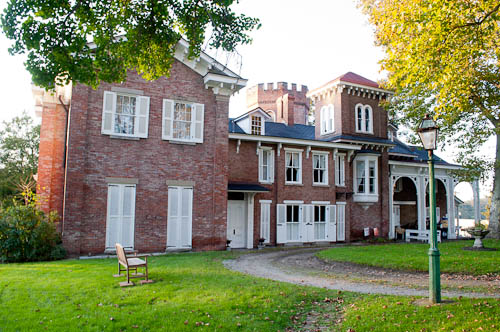
I posted above a photo that I took of our own house yesterday. Our house was built in the 1890’s and we like historic architecture. We also like having lived in the twentieth and the twenty-first centuries. I imagine that most of the readers of “Yesteryear” also like living in the year 2026. Otherwise, they wouldn’t choose to read a book about how awful it is to live in the past.

O.J. Simpson and His White Bronco Upstaged this High School Civics Banquet

This photo was taken on June 17, 1994, while the police chased O.J. Simpson in his white Ford Bronco.

The American Legion Auxilliary (it was called the American Legion Ladies Auxillary when I was a kid) chose me to represent my school at Keystone Girls State in 1994. The Berlin chapter usually just sent one girl, but in 1994 they sent two girls. I think that the American Legion (no Ladies in that name) was supposed to send a boy from my high school to Keystone Boys State as well. No boys applied, thus they funded two girls.

Girls State and Boys State are one-week programs held on college campuses in almost every state to teach rising high school seniors about civics and citizenship, American-Legion style. The programs held in Pennsylvania have “Keystone” at the beginning of their names because Pennsylvania is the Keystone State.

At the end of the week, we held “State Elections.” We elected one girl as “Governor” of Keystone Girls State. This lucky girl received a trip to Washington, D.C. to attend Girls Nation along with the girls elected as “Governors” of the other Girls States. Boys State also holds elections. They send delegates to Boys Nation. However, they are set up differently. (Note: I haven’t seen this documentary, but apparently it touches on the differences.)

My parents strongly encouraged me to sign up for anything that would “look good on a college scholarship application.” I wasn’t down with sports or STEM. I really enjoyed my Social Studies and History classes. So, I threw my hat in the ring for this fine opportunity. Two of my younger sisters also attended Keystone Girls State the summers before their own senior years of high school.

Per this Wikipedia page, “In 2020, the New York Post published an article citing Boys Nation and Boys State as summer camps that groom future presidents and governors.

If a program attracts thousands of kids with enough of an interest in politics for them to give up part of their summer vacations to do politics, then it makes sense to me that some of those kids eventually achieve success in politics.

If you listen to the podcast “The Dollop with Dave Anthony and Gareth Reynolds,” then check out the first few minutes of “Episode 456- Scott Walker.” Future Wisconsin Governor Scott Walker attended Badger Boys State. (Wisconsin is the Badger State.) Walker then got sent to represent Wisconsin at Boys Nation in Washington, D.C. There, he met Ronald Reagan. The Dollop referred to the program as a “Model UN ripoff.”

I don’t know anything about Model UN (Model United Nations) because my school didn’t offer an option to attend Model UN. I bet that the types of kids who attend Model UN are the same types of kids who attend Girls State and Boys State, though. They most likely have parents who encourage them to sign up for anything that could increase their chances of getting into a good college and / or receive money to fund their attendance at that good college.

We lived in a college dorm for a week at Shippensburg University. When we checked in, we received housing assignments that corresponded with our “city” assignment. We also received an assignment to one of two political parties. Each city had an equal number of citizens from each of these parties. The parties were NOT related to any existing political party in the United States. They just happened to have the same primary colors.

We lived on the same floor and in the same section of that floor with every other citizen of our “city.” The authority figure who lived on our floor as a sort-of Camp Counselor / RA was Mrs. Heeter. So, the name of our “city” was “Heeter City.” The photo at the top of this blog post are the citizens of Heeter City. On the first evening, we gathered for a Heeter City town hall.

The activities during that week were stuff that you would expect from a civics camp run by the American Legion. We had flag raising and flag-lowering ceremonies every day. We had lectures on flag ettiquette. We had “General Assembly” sessions where people gave speeches and held debates. We practiced parliamentary procedure.

The dress code was professional attire. My first office job after college was for a financial services company owned by the chair of that county’s Repubican Party committee. The dress code for that job was the same as the dress code for Keystone Girls State in 1994.

We knew about the dress code ahead of time because the American Legion or the American Legion Ladies Auxilliery sent us a list of what to pack. In addition to the office clothes, they asked us to bring a dress for the end-of-the week banquet. I think that they referred to it as an “Inauguration Ball” for the winners of all of the state elections.

A lot of the girls brought the dresses that they wore to their high school proms that spring. That’s why the photo at the top of this post includes a lot of girls wearing prom dresses. Obviously not everyone had a junior prom dress. The citizens of Heeter City posed for this photo at the banquet / Inauguration Ball. I am standing in the top row with most of the other tall girls, fourth from the left. I am wearing the blue prom dress that my mom sewed for me. A girl who was good at art volunteered to draw our city’s official “sign.” (Nobody voluntold her to draw it.)

We moved into the dorm at Shippensburg University on Sunday, June 12, 1994. On the opposite side of the U.S. on this same day, a woman named Nicole Brown Simpson and a man named Ronald Goldman were murdered at Nicole’s residence. Wikipedia told me that it was evening on the West Coast when this happened. We had already met our fellow citizens of Heeter City and we were probably asleep in our new beds. My new roommate had already had a heated conversation with her boyfriend on the landline phone in our room.

I had never heard the names Nicole Brown Simpson or Ronald Goldman before. Nicole’s former husband was retired football player and movie star O.J. Simpson. I had no idea who O.J. Simpson was, even though I had probably watched the first Naked Gun movie by 1994 and O.J. Simpson was one of the actors in that movie. He had also appeared in an orange juice commercial that I had seen.

Our dorm had a television in the lounge. Early in that week, I watched a teaser for the tabloid show Hard Copy. It called out the double murders of the former wife of a football player-turned-movie star, and also of her male friend. I didn’t watch the actual show because I was busy doing politics with other strivers.

By the middle of the week, both of the political parties at Keystone Girls State held state primaries. These were the elections which decided which candidates from each party would run for the Keystone Girls State general election on Friday. One of the citizens from Heeter City won her party primary to run for State Treasurer, and one of the citizens from Heeter City won her party primary to run for State Governor!

By that point in time, we had already been lectured at General Assembly because one day at the flag raising ceremony, somebody had responded to the American flag with a formal military hand salute. This was not appropriate because we were not veterans or wearing military uniforms. One day they let us wear shorts to General Assembly because of the hot June weather. This relaxation of the dress code was revoked the next day because people started to prop their feet on the seats in front of them. Hopefully a professional dress code would encourage people to sit professionally.

Somebody gave a speech in General Assembly that maintained that “nobody should get a free lunch.” Another citizen of Girls State advised that she was offended because her family qualified for free lunch at her school. The original speech-giver clarified that she only mean it as a colloquialism, and no offense was intended.

My roommate at Heeter City fought with her boyfriend over our room’s phone every night. She insisted to him that she wasn’t talking to men at GIRLS STATE.

We held our general elections on Friday, June 17, 1994.

Our Heeter City citizen who won her primary for State Treasurer also won her general election! She was now the Treasurer of Keystone Girls State! The position didn’t have any actual responsibilities. She got to wear a cool-looking sash for the group photo and the Inauguration Ball. In the above photo, she sits to the left of Mrs. Heeter.

Our Heeter City citizen who won her primary for Governor lost in the general election. In my opinion, this was the only race in Girls State worth “winning.” The winner got to attend Girls Nation in the US Capitol. They might possibly meet President Clinton, since he attended Boys Nation when he was in high school. Such a bummer that she made it all this way, just to lose on the final night. She didn’t even get a cool-looking sash to wear. She is sitting, sash-less, to the right of Mrs. Heeter.

I watched Mrs. Heeter try to cheer her up as the Inauguration Ball emcee announced the general election winners. Losing elections is just a part of politics.

One of the other citizens of Heeter City (not my roommate) announced that she had called her boyfriend in between the photo-taking and dinner. He told her that some famous person that I had never heard of – some football player – was leading the police on a chase down a highway in L.A. This girl’s boyfriend was watching it unfold live on television when she called him.

A bunch of the girls at my table decided to cut out of dinner early and go watch the news coverage of the police chasing O.J. Simpson in his white Ford Bronco.

Very few people stuck around after they finished their dinners. When I returned to the dorm, citizens of the various cities sat around watching the coverage of the Bronco chase.

We all went home on Saturday morning. I may have exchanged a letter or two with one of the other citizens of Heeter City, but that all fell off pretty fast. I lost touch with every person that I met there. My high school classmate who also attended Girls State was assigned to a different city, so we didn’t know any of the same people from this.

O.J. Simpson was charged with two accounts of first degree murder for the deaths of Nicole Brown Simpson and Ronald Goldman. He was acquitted on October 3, 1995. On that day, I was a freshman at St. Vincent College. The school had a six-week long freshman orientation process. The afternoon of October 3 was the freshman class’s mandatory assembly on drug and alcohol use. (Yes, I am aware that this was already more than a month into the semester.) A bunch of the freshmen skipped the drug and alcohol assembly in order to watch the verdict in the murder trial. I attended this assembly. We were in the question-and-answer portion of it. Some kid confused the Dean of Students by asking her a bunch of questions about the results of drug and alcohol usage while operating farm equipment. Then, this other kid raised his hand, stood up, and announced that the jury had just acquitted O.J. Simpson. This guy had worn headphones to the assembly so that he could listen to the verdict on a radio. The Dean of Students announced the verdict over her microphone at the podium. This pretty much ended our drug and alcohol assembly.

I hope that the citizen who got elected as Governor had a good experience at Girls Nation. I am sure that the citizen of Heeter City who didn’t get elected found success doing other things. To my knowledge, none of my fellow citizens from Keystone Girls State have become Presidents. Maybe our time just hasn’t arrived yet.

Voluntold; The Story of the Time that My Dad Volunteered My Mom for a Project

This is my second grade soccer photo.

If anybody reading this blog identifies themself in this photo and they object to it, please reach out and I will put a big ‘ol Eat N’ Park Smiley Face or something over your mug. Most of this post is actually going to be about the team banner shown in this photo.

For the first few years after we moved to Berlin, I played AYSO soccer. A lot of my classmates also played AYSO soccer. The team in this photo was just one of many teams of kids my age who went to school in Berlin. Our AYSO teams were all co-ed. I later graduated from high school with many of the kids in this photo. The exceptions were the kids who were my age but were in other grades, and the kid who moved in junior high. (The birthday cut-off for teams for AYSO soccer was slightly different than the birthday cut-off for our school district.)

Berlin’s varsity soccer program started after I left high school. Our town didn’t have any “permanent” soccer facilities when I was a kid. The “soccer fields” that I played on during my short soccer career all became other things. For instance, most of our elementary school soccer games were held on a farmer’s then-fallow cornfield. A few years later, it became a planted cornfield. There was another, smaller “soccer field” in town where the kindergarten kids practiced and played their AYSO soccer games. We also played pick-up soccer with the neighborhood kids on the “kindergarten soccer field.” When I was in high school, the parents of one of those neighborhood kids custom built their Forever Home on the lot that was formerly the “kindergarten soccer field.”

(Disclaimer: I think that one of my childhood soccer fields was a fallow cornfield. I could be wrong about this. Maybe it was a wheatfield? I saw farms from my backyard. Our house was on the very edge of town. We certainly smelled them. My entire eighth grade class was required to take Vocational Agriculture. A lot of my classmates lived on farms and I didn’t. I mis-remember a lot of things, so I could be wrong about the corn.)

My soccer career started in March of second grade, a few months after we moved into “Joe’s House.” I am pretty sure that my soccer career was my dad’s idea.

Now it’s time to talk about something else that was my dad’s idea.

Dad took me to my soccer team’s introductory meeting, held in the school cafeteria. This was where we learned the rules, and voted on a team name. (“Firebolts” won the vote for team name.) This was also the meeting where the coach asked for a volunteer to make the team banner. Our team’s official sponsor was Keidel’s Hardware. Both the team name and the team banner needed to include Keidel’s. Spoiler: my dad volunteered my mom to make the team banner! And she wasn’t there! She was at home with their other two young kids.

I do remember how all of this went down. We came home from the soccer meeting. My dad said to my mom something like, “I volunteered you to make the banner since you like to sew!” My mom wasn’t as excited as my dad was.

Less than two months later, my parents purchased their house in Berlin. My mom repainted the living room while we were at school. My parents moved all of our stuff out of “Joe’s House” and into “Our House.” I celebrated my First Communion at our new Catholic parish the same month that we moved into Chez Gaffron. Mom found out during my First Communion rehearsal that every mom there except for her had planned a family party to celebrate their child’s First Communion. (Mom’s own parents didn’t “do” First Communion parties. Dad’s family were Protestants. Mom didn’t realize that First Communion parties were a thing. She threw one together for me. Our extended family showed up so that they could see my parents’ new house. I got a cake and presents, and it wasn’t even my birthday yet.)

My first soccer game happened a week after we moved and a week or so before my First Communion.

I understand why Mom didn’t realize that when she dropped me off for the warmup before my first soccer game, that she was also supposed to drop off the banner. There was a lot going on in our family. Also, Mom didn’t want to make the banner in the first place.

The coach and the “team mother,” or whatever they called the woman who organized everything, said to me, “Jenny, where is the banner that your mom made?”

I didn’t know. (I think that she was at my younger sister’s soccer game, which was probably held at the exact same time, at the “Kindergarten Soccer Field” that I mentioned above.)

They asked me for my parents’ new phone number. I didn’t know that either. We had only moved a week earlier.

Someone tracked my mom down (probably at my sister’s soccer game) and asked her to bring the banner to my soccer game.

Mom showed up at my soccer game with the banner and explained, “I haven’t finished it yet.”

I don’t think that Mom ever finished the team banner for Keidel’s Firebolts. The top of the banner looks sort of “unpopulated” in our team photo. However, the bottom of the banner has a cool-looking thunderbolt. You just can’t see it because kids are standing in front of it in this photo. So maybe that was her artistic vision for it. Mom was very talented in multiple textile arts, although we never said it like that. We just said, “Mom is good at sewing,” or “Mom is good at needlepoint,” or “Mom is good at crochet,” or “Mom just taught herself how to knit a sweater from watching YouTube videos,” or “Mom owns a lot of yarn.”

Mom also sewed her own wedding dress. I plan to post a photo of it soon. Unlike the soccer banner for Keidel’s Firebolts, Mom decided on her own to make her wedding dress. We still have it and cherish it very much, just as I cherish the memories of my parents during our first spring in Berlin.

Snyder of Berlin and the “Joe’s House” Era

My four sisters and I sold the house where we all grew up, in Berlin, PA, a little over a year ago, after our dad died.

A few months ago, I learned that the company who owned the town’s potato chip factory intended to shutter it. The news was so shocking that my sisters and I texted each other about it. The Chip Plant? Oh, no, not the Chip Plant!

(We all called it the “Chip Plant.”)

Snyder of Berlin potato chips were one of my first introductions to Berlin.

My parents moved us to Somerset County when I was seven years old. My dad had accepted a position teaching Special Education at Somerset Area High School. Berlin is not in the Somerset Area School District. Berlin is in the Berlin Brothersvalley School District. My dad’s brother and the brother’s family lived a few miles outside of Berlin. My dad wanted to live close to my uncle. So, he rented a house a mile or two down the highway from my uncle. My dad knew that it would be an “easy” commute to Somerset because my uncle also worked in Somerset.

My sisters and I called the rental house “Joe’s House.” My parents rented it from a man named Joe. They also rented the house from Joe’s wife (we called her Joe’s Wife) and Joe’s daughter, Rita.

Joe used to live in Joe’s House with his wife and several kids. All of the kids left the nest except Rita. Joe, Joe’s Wife, and Rita moved out of their house and into an apartment on top of their garage. Then Joe rented Joe’s House to my parents.

Joe’s Garage was actually Joe’s Welding Shop. Joe’s Wife worked at Snyder of Berlin. The day after my parents moved us into Joe’s House, Joe’s Wife brought us several bags of Snyder of Berlin potato chips. She introduced us to the potato chip brand and to the role of Snyder of Berlin in our new community.

A few days later, I visited Berlin for the first time. The potato chip factory was a short walk down a residential street from our new school.

Rita rode the school bus with me and my sister K. Rita was a senior in high school. I was in the second grade. K. was in kindergarten. The Berlin Brothersvalley School District at that time educated their entire student population in two buildings connected by an “underground tunnel.” (Just like the US Capitol, except that it was traversed each day by a few hundred kids.) I thought that Rita was cool because she sat with (and horseplayed with) the other high school kids in the back of the bus.

Rita told me that my new bedroom at “Joe’s House” had been her bedroom. You know, before her parents moved her out of her house and rented the house to another family. Rita had to ride the bus each morning with the little girls who now slept in “her” bedroom.

I wonder if we should have all called the house “Rita’s House.”

A few months after my family moved into Joe’s House, we moved out of Joe’s House. My parents found a house to purchase in the town of Berlin. We walked to school. Berlin was small enough that we rode our bikes to every corner of the town. I often rode my bike past the Chip Plant.

Rita graduated from high school. I saw her name proudly written on a paper graduation cap taped to the wall of our shared school cafeteria. I was proud that I, a newcomer and a second grader, recognized a name on that wall. I graduated from that same school ten years later.

I smelled fried potatoes on windy days while I sat in class. We took Economics and did Junior Achievement in our senior year. As our “field trip,” we walked down the street and toured the Snyder of Berlin factory. There were 78 of us in my senior class. We divided ourselves into groups of five to ten each and laughed at the hair nets that we all wore. Some of my classmates waved at their family members working on the assembly line. When my sister K. took Economics / Junior Achievement two years later, a manager from the Snyder plant visited their class several times. He gave her a bunch of Snyder swag.

Every time my family rode past Joe’s House, we explained, “That’s Joe’s House!” Then a few moments later we pointed out the house that my uncle and aunt used to own. Two of my sisters were born after the “Joe’s House” era, so they needed to know about it.

I’m not going to get into the details about why the potato chip factory in Berlin got shuttered. You can Google all that. However, it closed last month.

I assume that Joe’s Wife eventually retired from the Chip Plant. However, a bunch of my former classmates and / or their family members probably didn’t have this opportunity. The Chip Plant’s role in Berlin will be hard to replace.

My Great-Grandfather Left His Immigrant Family to Serve in World War I, Become a POW, and Lose the Use of His Arm

I will occasionally blog about stuff that my sisters and I found when we cleaned out our late parents’ house.

For instance, here are two books that we found. They belonged to our paternal great-grandfather, Leonard Robert Gaffron. (My uncle Leonard and my father Robert were both named after him.)

Leonard Gaffron was a veteran of World War I.

The book above says on the cover:

80th

DIVISION

SUMMARY OF OPERATIONS

IN THE

WORLD WAR

PREPARED BY THE

AMERICAN BATTLE MONUMENTS

COMMISSION

The inside page says the same thing, with this added:

United States Government

Printing Office

1944

So, while my grandfather Carl was away serving in World War II in 1944, his own father, Leonard, received a book from the US government about a summary of operations in World War I.

The second book says the following on the cover:

WAR DIARY

of

COMPANY “E”

320TH INFANTRY

Compiled upon the occasion of the Eighth Annual Reunion, commemorating the Tenth Anniversary of the Company’s organization at Camp Lee, Virginia

September Nineteen Seventeen

June Nineteen Nineteen

The inside page says:

DEDICATED to all the men of Company “E”, 320th Infantry [80th Division], who made the supreme sacrifice.

According to family lore, Leonard Gaffron was a tremendous athlete. Before the War, he pitched a no hitter in a local baseball game. During the War, the Germans wounded him in the arm that he used to pitch the no-hitter. The Germans also took him prisoner. The Germans released him, but he lost the use of that arm due to his injury. At some point after the War, he went back to playing baseball- with his other arm. He pitched another no-hitter.

According to my dad, his Grandfather Gaffron earned a living by farming with one arm and two mules. He named one of the mules Kaiser Bill. (This was a reference to Kaiser Willhelm II, the German emperor during World War I.)

Years after World War I, a local newspaper interviewed my great-grandfather about his experience as a POW. My dad’s cousin brought a copy of this article to last year’s family reunion. He put the article up on a big screen so that we could all read it.

The article left out stuff that we Gaffrons had heard in the family lore. For instance, the article downplayed my great-grandfather’s ability to communicate with his German captors. My great-grandfather spoke German fluently. His parents were German immigrants.

My family concluded last fall that the article differed from the family lore because the article writer – or my great-grandfather, or both of them – didn’t want to draw attention to his German immigrant background. Somebody was apparently worried about the optics of his experience as a POW.

I never met Leonard Gaffron because he died before I was born. I have no idea if the Gaffrons who immigrated from Germany were a bunch of jerks. This doesn’t matter. Leonard had to farm and play baseball with one arm after he was captured as a POW in the War. From the family lore, the household struggled between World War I and World War II. The Great Depression happened, everyone struggled, but Leonard had to struggle with one arm.

Leonard’s son Carl went off to serve the U.S. in World War II. Then Carl came home and eventually married into another German immigrant family.

While we consider ourselves Americans now, some used to consider us outsiders. Interesting how a generation or two can affect our viewpoints.

St. Mary of Czestochowa Parish Blessing of Food Baskets – Holy Saturday, Easter Weekend

St. Mary of Czestochowa Parish Blessing of Food Baskets, New Kensington, Saturday April 19, 2025
Rev. John Moineau, St. Mary of Czestochowa Parish Blessing of Food Baskets, New Kensington, Saturday April 19, 2025

Gettysburg Non-Battle Tales

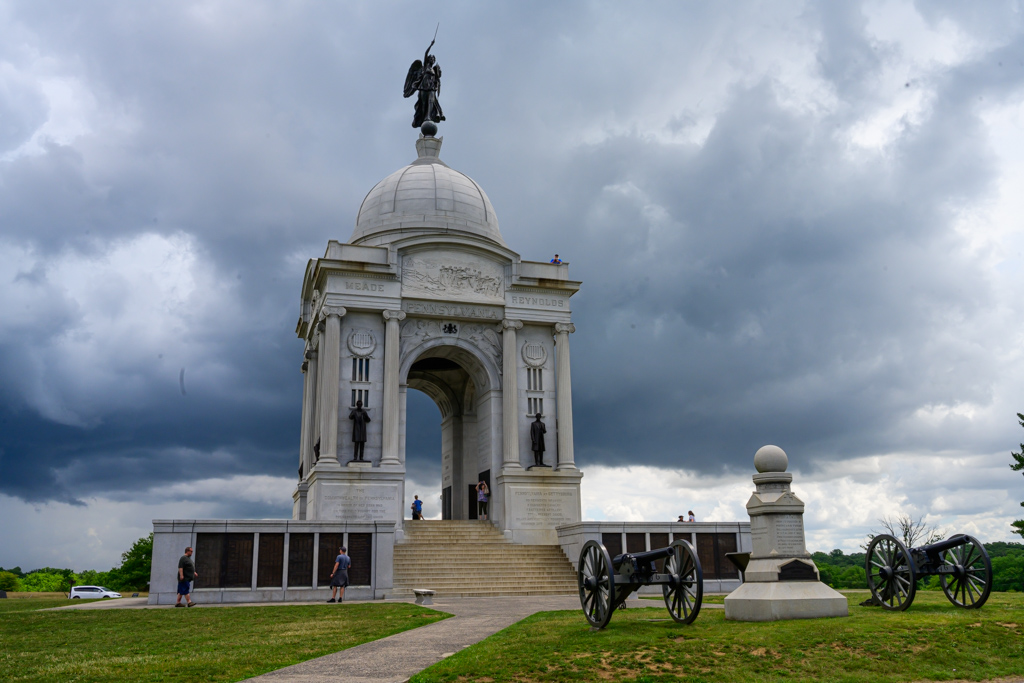
Photo by Jonathan Woytek, June 2023

Jonathan and I travelled to the Gettysburg area for a family event last month. Jonathan had never been to Gettysburg prior to this (except for driving past it on Route 30). So, after we checked out of our hotel, we drove around the battlefield before we drove home.

I learned the night before from a 12-year-old history buff that Little Round Top and Devil’s Den were both under remediation from the National Park Service and thus closed to the public.

“What else should we visit, then?” Jonathan asked me.

I remembered the Pennsylvania Monument and we directed Google maps to give us driving directions to it.

The Pennsylvania Monument is the largest state monument on the battlefield. The Commonwealth of Pennsylvania dedicated the uncompleted monument in 1910. The 50th anniversary commemoration for the battle happened in July 1913. The monument was completed in 1914 and rededicated on July 4, 1914. That’s what Wikipedia says, anyway.

(Wikipedia doesn’t mention this on the monument’s page, but Gavrilo Princip assassinated Archduke Franz Ferdinand on June 28, 1914. This set off a chain of events that resulted in the start of World War I on July 28, 1914. The United States entered World War I in April 1917.)

I didn’t bring my camera with me but Jonathan brought his. You can see the above photo and all of Jonathan’s other Gettysburg photos here on our other blog.

What Jonathan’s other photos didn’t show is this: shortly after we parked at the Pennsylvania monument, a bus bearing the name of a college in northern Michigan pulled up to the monument. Lots of college-looking kids poured out of the bus. A man who looked like a teacher reminded the kids to “remember your assignment.” The kids ascended to the top of the monument.

Now, on the PA monument, one can access a balcony underneath the dome at the top. In order to reach this balcony, you must climb the steps seen in the photo, and then climb a metal spiral staircase that is not seen in the photo.

I overhead a young man talking to a young woman. The young man must have been a member of a fire department, because he referenced “my district” and “fire call.” He told the young woman that the call was for a structure fire. The building in question had a spiral staircase “just like the one here.” He told her that the spiral staircase at said structure fire got very hot and that he had to carry a hose up it. “That was the worst fire call that I’ve ever had,” he said.

In order to get back on their bus, the Michigan college students had to tell their teacher which “spot” they had been assigned to identify, as they pointed in the direction of it. “Peach Orchard,” “Wheat Field,” “Devils Den,” “Little Round Top,” various students said.

A reenactment group positioned across the road from the PA monument demonstrated how to be Civil War infantry soldiers. They marched. They loaded rifles with powder. They fired. There were no bullets. We learned that the National Park Service doesn’t permit the use of bayonets on NPS grounds; nevertheless, we saw a bayonet demonstration sans bayonet. The NPS staffer identified the group as volunteers re-enacting a regiment from Maine. However, three of the men were actually from Germany.

A short trip down the road from the PA monument (the PA monument was still in sight) we stopped to look at some other monuments because a vulture sat on one of these other monuments. The vulture’s mate stood on the ground nearby, eating a squirrel. Jonathan photographed the turkey vulture on the monument. You can see two photos of it on our other blog.

Eventually, another car with a PA license plate pulled up next to our car.

“The vultures return at this same time of year, every year,” the driver told us.

It was about a week before the anniversary of the Battle of Gettysburg.

Jonathan said, “One of them was eating a squirrel before I scared it.”

The driver speculated about the vultures’ presence in July 1863.

“You know what they were feeding on back then, right?” he said.

Then he drove off.
Sunset at Mount Saint Peter

Mount Saint Peter Roman Catholic Church. New Kensington, Westmoreland County, Pennsylvania. May 7, 2021. (Photo: Jenny Gaffron Woytek)

Mount Saint Peter Roman Catholic Church. New Kensington, Westmoreland County, Pennsylvania. May 7, 2021. (Photo: Jenny Gaffron Woytek)
The Parnassus Pen All content copyright by author, unless otherwise noted.